
The Forgotten Bureaucrats Who Ran Bengal’s Navy
An empire’s navy is easy to imagine at sea: wooden vessels, oars cutting through water, soldiers waiting on the decks.
What is harder to picture is everything that had to happen before a fleet could move.
Ships needed to be built and maintained. Harbours had to function. Crews needed to be organised. Troops and supplies had to cross rivers. Someone had to know the waterways well enough to steer a vessel through them, while someone else had to coordinate the larger system.
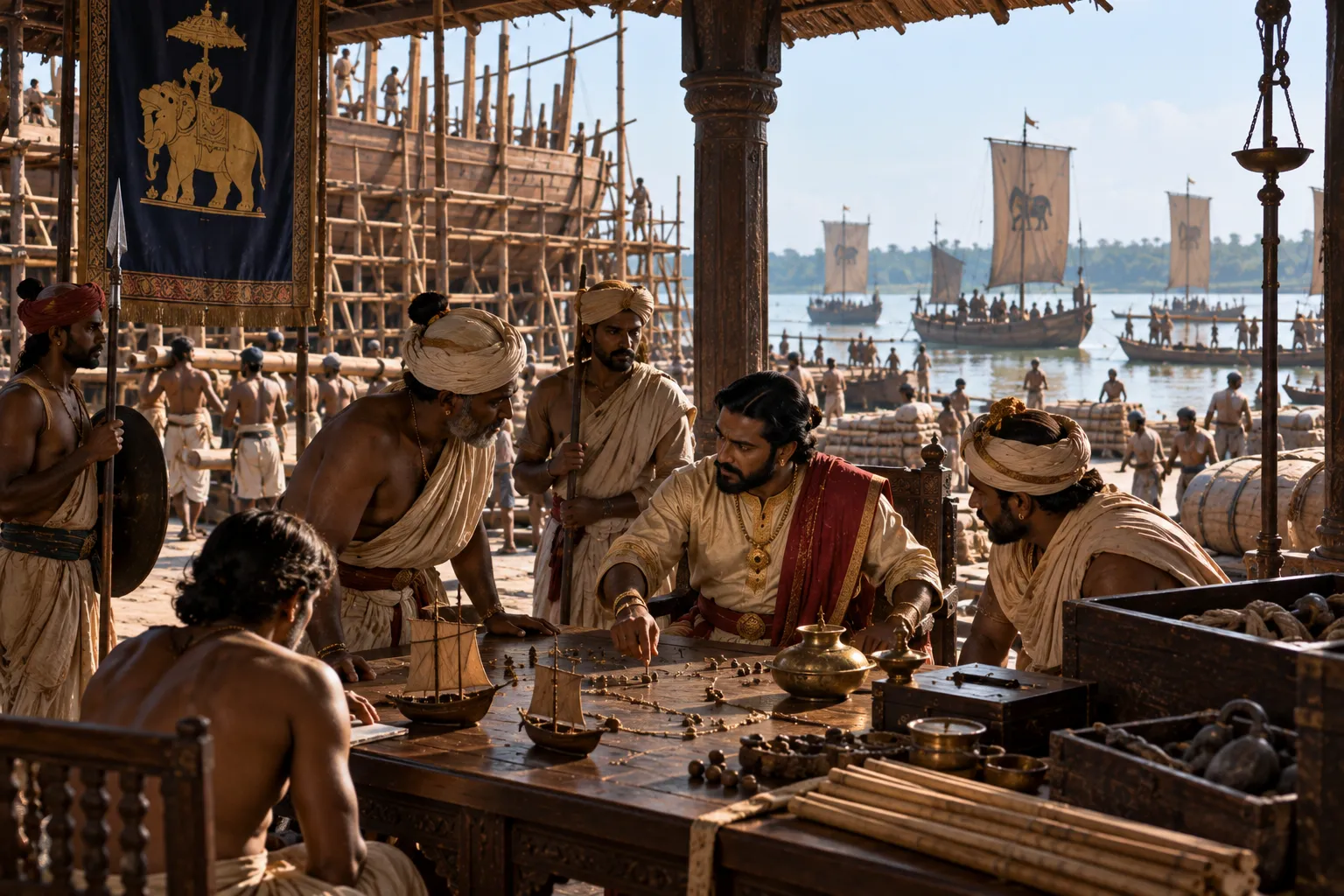
The Palas appear to have understood this. Their naval power was not simply a collection of boats. It was supported by an administrative structure with specialised officials whose titles reveal how seriously the state treated work on the water.
A navy needs paperwork too
The surviving evidence is fragmentary, but the research identifies several Sanskrit titles associated with naval and riverine administration during the Pala period.
Among the most important was the Nau-Vyaprtaka, described in the research as a senior naval superintendent responsible for administrative affairs and procurement. Alongside it appear titles associated with ports, fleet command, navigation and river crossings.
The terminology matters because it changes the way we imagine an early medieval navy.
A fleet requires more than a commander giving orders. It requires an organisation capable of turning royal resources into functioning vessels, crews and transport.
That is what these otherwise obscure titles begin to reveal.
The people behind the fleet
The research reconstructs a hierarchy in which different officials appear to have had different responsibilities:
| Office | Function described in the research |
|---|---|
| Nau-Vyaprtaka | Senior naval administration and procurement |
| Naukadhyaksa | Higher naval command |
| Pattanadhyaksa | Administration of ports and naval bases |
| Nau-Karmika | Fleet or battle-group command |
| Karnadhara | Navigation and steering |
| Tarika | River crossings and troop movement |
The exact scope of these offices is not equally certain, and the terminology comes from different bodies of evidence. They should therefore not be imagined as a perfectly documented modern naval hierarchy.
But taken together, they point towards something important: waterborne power had specialised jobs.
The superintendent who made the system work
The Nau-Vyaprtaka is particularly revealing.
The word itself belongs to the administrative vocabulary of naval activity, and the research places this official near the centre of the organisation of the fleet. Procurement, maintenance and deployment were not tasks that could be left entirely to individual ship captains.
Someone had to make sure the resources existed.
That meant timber, equipment, vessels, crews and the infrastructure needed to keep them operating. The research goes further and portrays the Nau-Vyaprtaka as coordinating ship construction across the delta, although the surviving evidence does not allow us to reconstruct the scale of that activity with confidence.
The more cautious conclusion is still striking: the Pala state had officials whose responsibilities were specifically connected with naval administration.
A port was more than a place to park boats
Another title, Pattanadhyaksa, connects naval organisation with the administration of ports.
That matters because a port was where several systems met.
Ships arrived. Goods moved. People crossed between land and water. Customs and commercial activity had to be regulated. Military vessels could use the same maritime infrastructure that supported commerce.
The research associates the Pattanadhyaksa with the supervision of naval bases and commercial harbours and with the observance of port customs.
This suggests that naval power was embedded within the wider economic geography of Bengal rather than existing as an isolated military institution.
The same waterfront could serve commerce, transport and the state.
Someone still had to steer
At the other end of the hierarchy was a much more practical figure: the Karnadhara.
The term refers to the person responsible for steering or navigation. Unlike a senior administrator, this was an intensely practical role. A ship could possess excellent timber, a trained crew and a military objective, but none of that mattered if it could not be guided through the water.
In Bengal, that was no trivial responsibility.
The waterways were complex, and the difference between a usable channel and a dangerous one could be considerable. Navigation was therefore not simply a subordinate technical task. It was one of the essential skills on which the entire naval system depended.
This connects directly with the river knowledge explored in When a Fisherman’s Knowledge Became Military Power.
The state could appoint a naval official. It could not manufacture river knowledge overnight.
Moving an army across water
The Tarika represents another side of naval administration: logistics.
The research associates this official with managing river crossings and the movement of ground troops across major waterways.
That role reminds us that a medieval navy did not necessarily exist only to fight other ships.
In a riverine country, moving an army could itself be a naval operation.
Soldiers, horses, weapons, provisions and equipment all had to cross water. A fleet that could transport them could alter the speed and direction of a military campaign. The ability to move an army across a river could be as strategically important as the ability to attack an enemy vessel.
The boundary between “army” and “navy” was therefore much less rigid than the modern distinction suggests.
Commanders, crews and administration
The research also identifies the Naukadhyaksa as a senior naval commander and the Nau-Karmika with tactical command of fleet units or battle groups.
These titles suggest different layers of responsibility: someone had to oversee naval affairs at the highest level, while other officers dealt with the practical command of formations.
But we should resist the temptation to turn these terms into a complete organisational chart.
The evidence does not give us a personnel register, an admiralty building or a detailed description of how every office interacted. Nor can every title confidently be assigned to a single fixed rank throughout the Pala and Sena periods.
What survives instead are fragments of an administrative vocabulary.
And those fragments are enough to show that the state had names for specialised naval work.
The navy became part of government
This may be the most important discovery hidden inside these obscure titles.
When a state creates specialised offices for an activity, that activity has usually become too important to leave informal.
A fishing community can operate boats without an admiralty. Traders can organise voyages without a military bureaucracy. But a large kingdom that needs vessels for transport, defence, communication and warfare requires coordination.
The Pala evidence suggests that naval affairs had entered that administrative world.
The fleet was therefore not simply something a king possessed.
It was something the government had to organise.
From Pala to Sena
The terminology appears to change as Bengal moved into the Sena period.
The research notes the emergence of Nau-bala-Vyaprtaka, incorporating bala, meaning force or military power, into the title.
That change is suggestive, but it should not be treated as proof that the navy suddenly became militarised. Naval forces could already have had military functions under the Palas.
What the change does show is that naval administration remained part of the political vocabulary of Bengal into the Sena period.
The institution, or at least the idea of specialised naval administration, had survived beyond the dynasty that first provides us with clearer evidence for it.
The forgotten side of naval power
Historical memory tends to preserve spectacular things.
A victorious king survives in an inscription. A famous battle acquires a date. A great ship can become an archaeological discovery.
The official who arranged supplies is much easier to forget.
Yet without such people, fleets remain imaginary.
The Nau-Vyaprtaka, Pattanadhyaksa, Naukadhyaksa, Nau-Karmika, Karnadhara and Tarika represent different pieces of the same puzzle. Some dealt with administration, some with command, some with ports, some with navigation and some with the movement of troops.
Together, they reveal a simple truth that is easy to overlook: Bengal’s naval capability depended not only on people who could sail, but on a state capable of organising everything that sailing required.
The ships may have disappeared. The bureaucrats left fewer traces.
But their titles survive—and in those titles, we can glimpse the machinery that once made Bengal’s navy possible.