
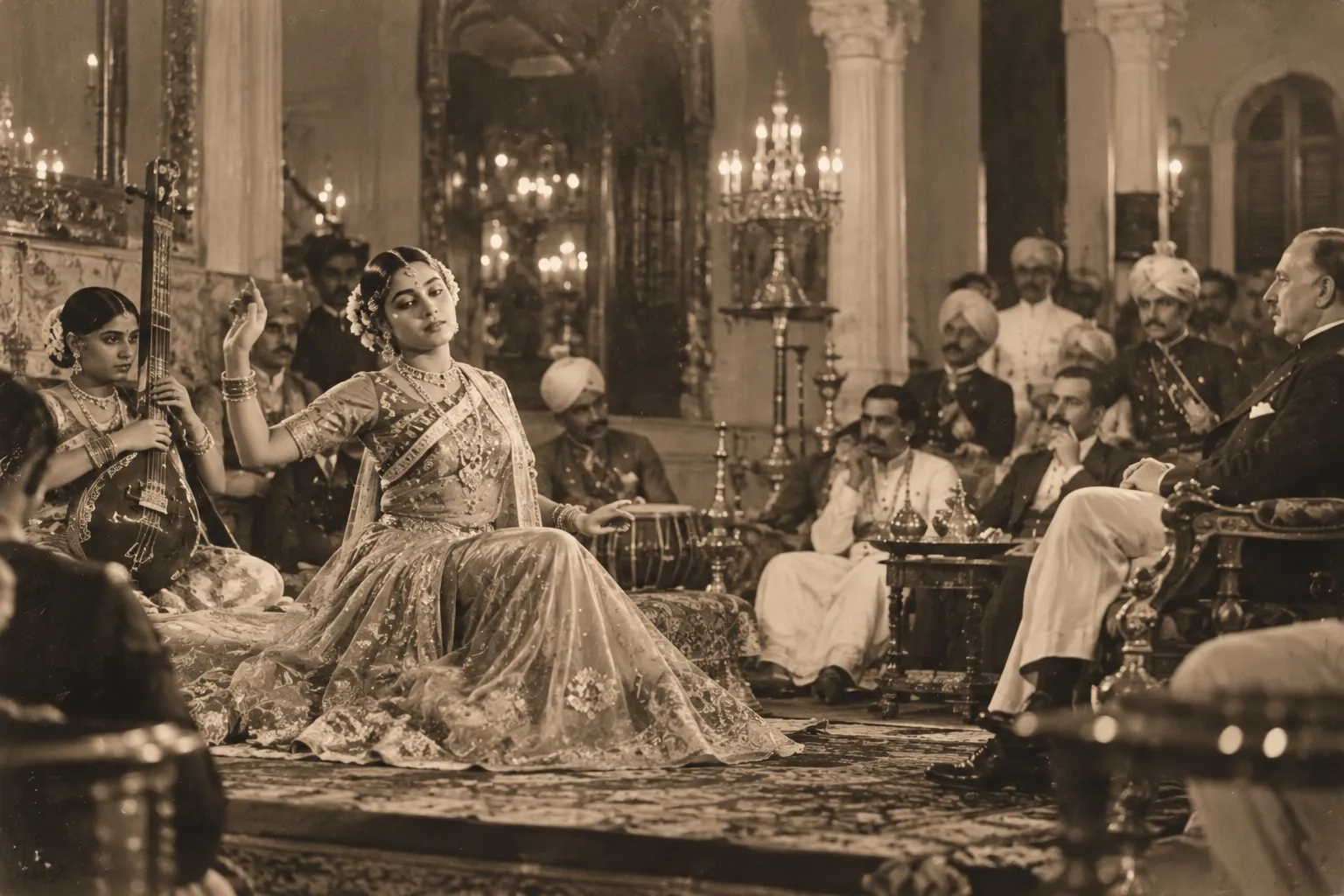
Nikki Bai: The Most Expensive Voice in Colonial Calcutta
In nineteenth-century Calcutta, a great singer did not need a concert hall to command an extraordinary fee.
She needed a wealthy patron, a private mansion and a reputation powerful enough to make the city’s elite compete for her presence.
Nikki Bai—also recorded as Nikhee or Nicky—was one of those performers. For more than two decades, she occupied an unusual position in Calcutta’s musical world: celebrated by Indian patrons, admired by European visitors and paid sums that reveal just how valuable elite entertainment could become in the colonial city.
Her story is, in part, the story of the economics of celebrity before the age of recordings.
The woman they called the “Catalani of the East”
European visitors to Calcutta struggled to describe Nikki in terms their readers would immediately understand.
When Fanny Parkes attended a party at the house of Raja Rammohun Roy in 1823, she encountered several nautch girls performing music and dance. Among them was Nikki.
Parkes’s description was strikingly brief:
“One of the women was Nickee, the Catalani of the East.”
The comparison was not casual. Angelica Catalani was one of Europe’s celebrated sopranos, famous across the continent. For a European visitor to apply her name to a Calcutta performer tells us something about Nikki’s reputation.
She was not simply another entertainer hired for a wealthy man’s evening.
She was a celebrity.
Sumanta Banerjee, in Under the Raj: Prostitution in Colonial Bengal, notes that Nikki was compared by European listeners not only with Catalani but also with the German soprano Elizabeth Billington. Banerjee describes Nikki as the most famous of the elite baijis of her period and says that she appears repeatedly in contemporary accounts of Calcutta’s fashionable society.
What was a night with Nikki worth?
This is where the story becomes extraordinary.
One account preserved by Banerjee records that the price of Nikki’s attendance for three nights was 1,200 rupees, plus two pairs of shawls of equivalent value.
The account’s own explanation is revealing: the writer considered this enormous payment justified by her “singular accomplishments.”
Another visitor, Emma Roberts, wrote in 1835 that Nikki was receiving 1,000 rupees for a single night’s performance wherever she was engaged.
And in 1819, a contemporary Bengali newspaper reported that a wealthy Bengali patron was maintaining Nikki exclusively on a monthly allowance of 1,000 rupees. A later account of the period similarly describes a rich zamindar employing her regularly at that salary.
The numbers need some perspective.
A historical comparison cited in discussions of early nineteenth-century Bengal places the monthly income of an ordinary labourer at only a few rupees, while skilled artisans earned considerably more. That means Nikki’s reported fees represented many years—indeed, decades—of ordinary earnings.
Put into today’s terms, the comparison can only be approximate. If we use contemporary wages simply to illustrate the scale, ₹1,200 could be thought of as roughly ₹30–40 lakh and more today. That is not a literal inflation conversion; it is a way of showing the extraordinary purchasing power represented by the fee.
And this produces a fascinating modern comparison.
Recent media reports have put Shreya Ghoshal’s live-performance remuneration at around ₹20–25 lakh per concert, although such celebrity fees are rarely officially disclosed and reports vary.
The comparison is not meant to suggest that Nikki and a modern concert singer operated in equivalent markets. They obviously did not. But it gives a contemporary reader a useful sense of scale: a reported payment to Nikki, when translated very roughly through historical earning power, could reach the territory of what a major Indian singer might command for a modern live performance.
For a private performance in a nineteenth-century mansion, that is remarkable.
Why would anyone pay so much?
Because the wealthy men of Calcutta were not buying music alone.
They were buying access, distinction and reputation.
The emerging Babu elite had acquired enormous fortunes through commerce, Company administration, landholding and other parts of the colonial economy. But wealth created another problem: how could a recently wealthy family make its status visible?
The answer often involved elaborate houses, festivals, religious ceremonies, European guests, expensive food, imported goods—and celebrated performers.
A famous baiji could transform a private gathering into an event.
The more difficult she was to obtain, the greater the prestige of having her.
Nikki’s value therefore operated partly through scarcity. If competing wealthy patrons wanted the same performer, her fee could rise accordingly. The market was not simply for singing and dancing; it was also a market for social distinction.
Her monthly arrangement is particularly revealing. A patron paying 1,000 rupees every month was not merely purchasing an evening’s entertainment. He was effectively securing privileged access to one of the most celebrated performers in Calcutta.
A celebrity without a stage
Nikki’s career also shows how different celebrity could look before the modern entertainment industry.
There were no recording contracts, streaming platforms, ticketed arenas or mass newspapers capable of turning a performer into a national star overnight.
Her stage was the jalsaghar and the aristocratic mansion.
Her audience consisted of zamindars, Babus, British officials, European visitors and other members of Calcutta’s wealthy society.
Yet her reputation travelled far beyond those rooms.
Fanny Parkes wrote about her. Lady Nugent had encountered her. Emma Roberts recorded her extraordinary fee. Newspapers reported her employment.
And European visitors repeatedly tried to place her within a musical hierarchy they already understood.
That is why “Catalani of the East” is such a revealing description. Nikki had become famous enough that Europeans needed a European comparison to explain her fame.
But the price came with a contradiction
There is an uncomfortable side to this extraordinary success.
The elite baiji occupied a socially ambiguous world. She could possess remarkable artistic training, command extraordinary fees and exercise considerable professional independence while still being treated by respectable society as a woman whose social status was fundamentally suspect.
Banerjee describes this world as a kind of “twilight zone”: these women pursued independent careers as professional singers and dancers, but their position could also be entangled with systems of concubinage and patronage.
Nikki’s wealth therefore did not necessarily translate into conventional respectability.
Her price demonstrated her power in one social arena while the very profession that made her valuable could place her outside another.
That contradiction would become increasingly important as nineteenth-century ideas of respectable womanhood changed.
What Nikki’s fortune tells us about Calcutta
Nikki Bai’s story is ultimately larger than one performer.
Her fees reveal the extraordinary amount of money circulating through the private cultural economy of colonial Calcutta. They show how the city’s newly wealthy elite spent money not only to enjoy culture, but to possess distinction.
A celebrated performer could become part of the architecture of status.
The mansion provided the setting. The patron supplied the money. The guests supplied the audience.
And Nikki supplied something that money alone could not manufacture: a reputation everyone already recognised.
Long before the gramophone turned voices into commodities that could be bought and replayed at home, Nikki Bai had already demonstrated another possibility.
A voice could become so valuable that wealthy men would compete to buy an evening of it.
And in colonial Calcutta, that could mean a fortune for a few nights of music.