
How Calcutta’s New Rich Became the Babus
In nineteenth-century Calcutta, wealth could change a man’s place in society almost as quickly as it changed the house he lived in.
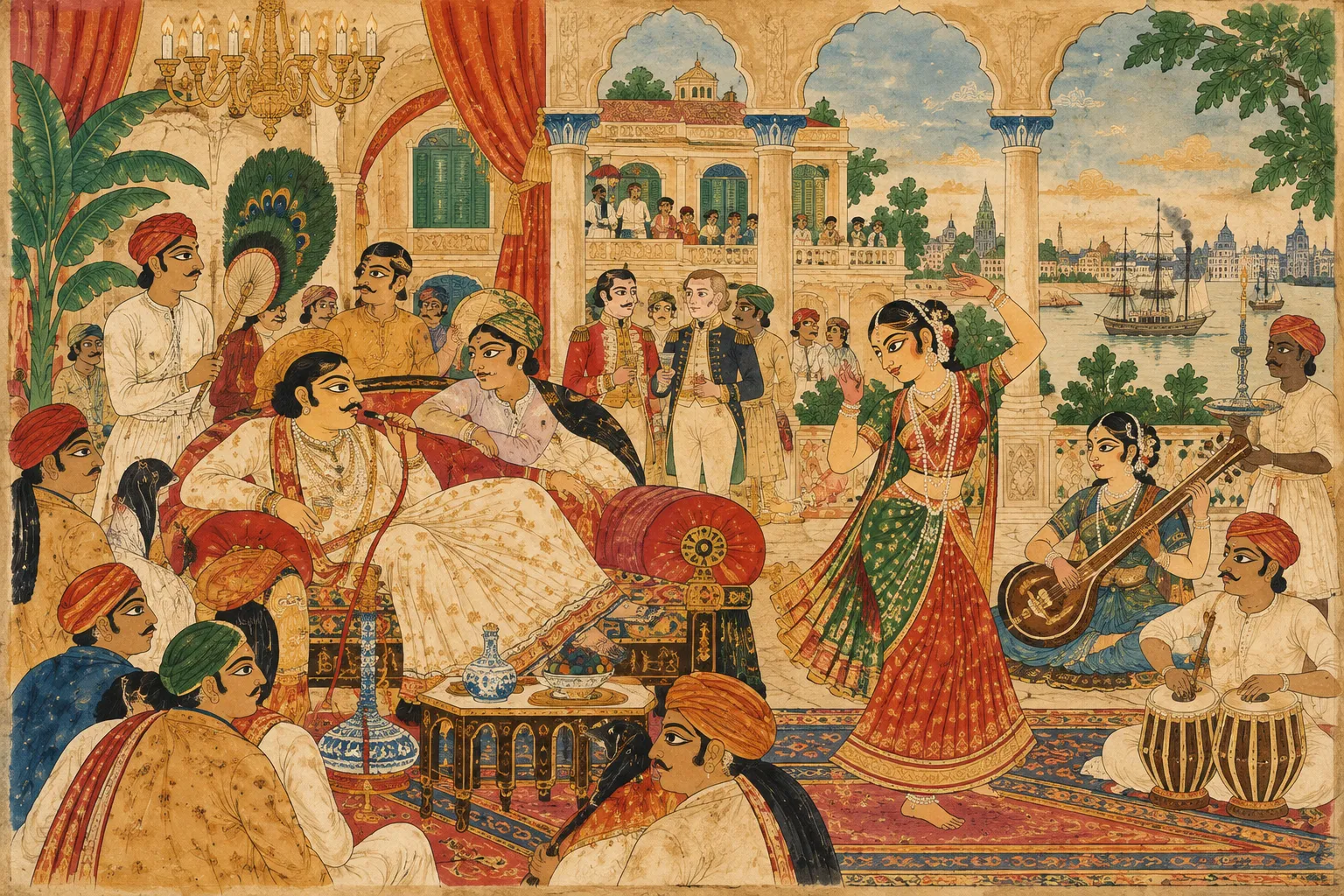
Men who had risen through commerce, Company administration, revenue collection and landholding began building enormous houses in north Calcutta. They sponsored temples, staged elaborate Durga Puja celebrations, employed celebrated musicians and performers, entertained European officials and competed with one another in displays of wealth.
They became known as Babus.
The word had not always carried the meaning it acquired in colonial Calcutta. What emerged was not simply a group of rich men, but a new social type: an elite whose wealth was tied to the changing machinery of British rule, and who now had to turn that wealth into something more difficult—social status.
This was how Babu culture began.
The colonial economy opened a new door
The transformation began in the eighteenth century, as the East India Company expanded from a trading corporation into a territorial power.
The Company needed people who could operate between its European officials and the Indian economy: interpreters, accountants, brokers, revenue managers and commercial intermediaries. Bengali merchants and banians became important participants in this world, working with European merchants and companies.
Some accumulated fortunes through these relationships.
Then came the Permanent Settlement of 1793.
The settlement fixed the land revenue that zamindars were expected to pay to the Company and recognised them as hereditary proprietors of their estates. For people who acquired or consolidated zamindari holdings, this created the possibility of retaining growing surpluses when agricultural rents increased while the state’s demand remained fixed.
The result was a new kind of wealth: money that could accumulate through land, commerce and intermediary positions without requiring its owner to belong to an ancient aristocratic lineage.
The research papers describe this as a crucial mechanism behind the emergence of the Babu class. They also point to the displacement of older forms of aristocratic authority and the rise of men from merchant, administrative and commercial backgrounds.
Calcutta was becoming a city where money could create social possibilities that birth alone had once controlled.
But money was not enough
There was a problem.
A fortune could buy a mansion. It could not automatically buy prestige.
The men who became wealthy through Company-era commerce and landholding often lacked the hereditary authority of older aristocratic families. They therefore had to make their wealth visible—and make it meaningful.
They built enormous houses, sponsored temples and festivals, hired celebrated performers, entertained European officials and competed with one another in displays of wealth.
The mansion itself became a statement.
So did the festival.
So did the guest list.
Durga Puja became a competition
Nothing displayed this new social competition quite like Durga Puja.
A Calcutta Gazette report from 1814 described wealthy Hindu families competing in the “expense and profusion” of their celebrations, each attempting to “get a name amongst men.” Celebrated performers were hired by rival households, turning private mansions into temporary centres of music and spectacle.
This was religion, certainly. But it was also something else.
It was publicly visible wealth.
A family that could bring together famous performers, priests, musicians, guests and elaborate rituals was announcing its position to the entire city.
And the competition could become extraordinary.
The research records the funeral ceremony of Nimaicharan Mullick in 1787 at a reported cost of 30 lakh rupees. It describes the 1825 shradh of Ramdulal Dey’s sons for their father, involving thousands of priests, gifts of precious utensils, elephants, boats, carriages and alms to large numbers of poor people.
Whether every spectacular figure repeated in later accounts can be independently verified is another question. But the pattern of conspicuous ceremonial expenditure is well attested in contemporary and later accounts of elite Calcutta.
The message was unmistakable:
wealth had to be seen to count.
The Babu was a cultural invention too
The new elite did not simply accumulate money. They developed a distinctive way of living.
They combined elements of several worlds: Bengali ritual, older aristocratic habits, European education and manners, and the consumer culture of a rapidly expanding colonial city.
Sutapa Dutta’s study of the Bengali Babu describes this emerging culture as a mixture of Western aspirations and older Indian elite traditions. The Babu could cultivate English manners and education while simultaneously maintaining lavish entertainment, religious ceremonies and the pleasures of the nautch.
Sumanta Banerjee, in The Parlour and the Streets, places this new elite within the wider social transformation of nineteenth-century Calcutta, where a Western-influenced Bengali elite increasingly distinguished itself from the city’s popular and working cultures.
This produced a peculiar figure.
The Babu wanted to be modern—but not simply British.
He wanted refinement—but also spectacle.
He wanted the prestige of Europe while retaining the grandeur of the Bengali and Mughal past.
Calcutta’s great houses became the physical expression of that contradiction.
And then came the Baijis
Among the most important purchases of this new elite was not an object at all.
It was performance.
Celebrated Baijis became markers of wealth and cultural sophistication. The research records Nikhee, described in an 1814 newspaper as “the Billington of the East,” and a later report that a wealthy patron had engaged her for a monthly salary of Rs 1,000.
To possess the services of a celebrated performer was itself a statement.
The Babu was not merely buying music. He was demonstrating that he could afford access to something scarce.
This is where the story of the Babu becomes inseparable from the story of the Baiji—but they are not the same story. The Babu represented a new form of wealth seeking recognition. The Baiji occupied a sophisticated artistic economy that gave elite patrons access to music, dance, poetry and etiquette.
Together they created one of the most distinctive cultural marketplaces of nineteenth-century Calcutta.
From wealth to legitimacy
There was another reason the Babus invested so heavily in ritual and culture.
Wealth could be inherited. Legitimacy had to be constructed.
Temples, religious patronage, charitable giving, festivals and cultural institutions could transform a recent fortune into something that looked older and more permanent.
A successful merchant could become a landholder.
A landholder could become a patron.
A patron could become a household name.
And eventually, the household itself could become part of Calcutta’s history.
The great mansions of Pathuriaghata, Shobhabazar and Jorasanko were therefore more than residences. They were monuments to a social experiment: the conversion of colonial-era economic opportunity into Bengali elite identity. The papers describe this process as a movement from monetary capital towards social position, cultural authority and ritual legitimacy.
The Babu would eventually become a joke
There is an irony in what happened next.
The very extravagance that helped establish the Babu’s prestige eventually became the source of his caricature.
By the middle of the nineteenth century, writers and satirists were already turning the Babu into a recognizable comic figure. Kaliprasanna Singha’s Hutom Pyanchar Naksha became one of the great contemporary portraits of this changing Calcutta, lampooning the manners, pretensions and excesses of its elite. Dutta’s research also traces how the Babu became a target of both British and Bengali satire.
A new educated middle class was emerging with different ideas about respectability. Western education, professional achievement and disciplined domestic life increasingly offered alternative routes to status.
The old formula—wealth, spectacle, patronage—was beginning to look embarrassing.
The Babu had helped invent a new elite culture.
That culture would eventually outgrow him.
And yet, long after the caricature faded, the houses remained: vast courtyards, marble floors, temple rooms, thakur dalans and crumbling facades scattered through north Kolkata.
They are the physical remains of a moment when colonial power changed the routes to wealth—and a generation of Bengali men discovered that becoming rich was only the beginning.
They still had to become Babus.