
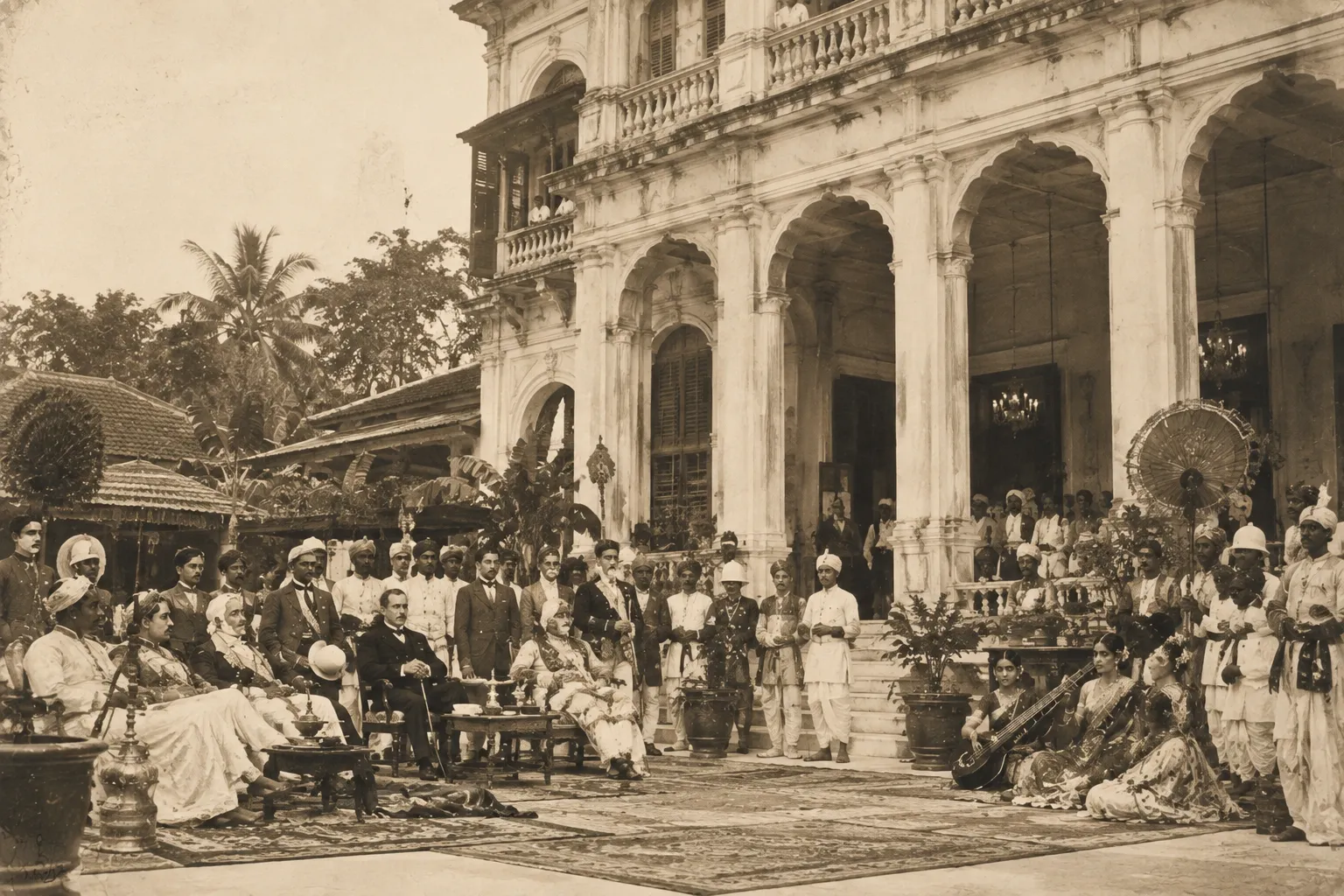
How New Money Became Old Power in Colonial Calcutta
In colonial Calcutta, becoming rich was only the first step.
A merchant could accumulate lakhs. A Company intermediary could build a fortune. A successful businessman could buy land, houses and influence. But wealth did not automatically make a man an aristocrat.
The old order had been built around lineage, inherited rank, land and ritual authority. The new elite had something different: money acquired through commerce, administration and proximity to the expanding power of the East India Company.
The challenge was to turn that money into something that looked permanent.
Calcutta’s newly wealthy men found ways to do exactly that.
The men who found the new routes to wealth
The foundations were laid in the eighteenth century as the East India Company transformed itself from a trading corporation into a territorial power.
The Company needed people who could work between its European officials and the Indian economy. Mutsuddis, banians, merchants, accountants, brokers and revenue intermediaries occupied this space.
For some, it became extraordinarily profitable.
Raja Nabakrishna Deb is one of the clearest early examples. Beginning as an interpreter and intermediary, he established himself within the expanding Company administration and accumulated substantial property and wealth. His career demonstrated something that would become increasingly important in Calcutta: proximity to the new colonial state could produce a fortune on a scale that earlier social hierarchies had not anticipated.
Then came the Permanent Settlement of 1793.
By establishing hereditary proprietary rights for zamindars and fixing the revenue demand payable to the Company, the settlement created new opportunities for the accumulation and consolidation of landed wealth. Men who had already made fortunes through commerce or administration could now convert some of that wealth into property.
Money could become land.
And land had a very different social meaning.
A fortune needed a family name
The newly rich faced a problem that money alone could not solve.
A fortune could be made quickly. Prestige usually took generations.
The solution was to make wealth visible, respectable and apparently permanent.
The great families of Calcutta invested in houses, temples, religious ceremonies, charitable activities and cultural patronage. Their residences became increasingly elaborate, while festivals and family rituals provided occasions for displaying wealth before the wider city.
A funeral or shradh could become a public demonstration of a family’s resources. Durga Puja became another arena in which wealthy households competed for recognition.
The scale could be extraordinary.
The research records Nimaicharan Mullick’s 1787 funeral ceremony at a reported cost of 30 lakh rupees. In 1825, the sons of Ramdulal Dey reportedly spent nearly five lakh rupees on their father’s shradh, involving thousands of priests, elaborate gifts and large-scale charitable distribution.
These ceremonies did more than consume money.
They converted money into reputation.
The mansion became a social machine
The great Calcutta house was therefore more than a residence.
It was a stage on which a family could demonstrate that its wealth had become something larger than private fortune.
Visitors came. Performers were hired. Religious ceremonies were conducted. British officials could be entertained. Artists and intellectuals could circulate through the household.
The family’s name became associated with a particular kind of magnificence.
This was particularly visible during Durga Puja. A Calcutta Gazette report from 1814 described wealthy Hindu families competing in “expense and profusion” in an effort to “get a name amongst men.” Famous performers were engaged by different households, turning private celebrations into highly visible contests of cultural prestige.
The logic was remarkably modern.
If people saw your wealth, they could recognise your importance.
And if that recognition was repeated every year, attached to a house and inherited by your children, a recent fortune could begin to look like an established aristocratic tradition.
Culture became a form of power
This is why the patronage of artists and Baijis mattered.
Hiring a celebrated performer was expensive. Access to the best musicians and dancers therefore became another way for wealthy families to distinguish themselves.
The research describes famous Baijis becoming markers of prosperity among Calcutta’s elite. During major celebrations, families competed for performers from places as far away as Lucknow and Delhi. Some influential Babus even secured the presence of senior British officials at their entertainments.
The performance was entertainment.
But it was also social currency.
A household that could attract a famous artist, a prominent British official and members of the city’s elite was demonstrating that it occupied a particular place in Calcutta’s hierarchy.
Money was becoming cultural authority.
But the transformation was not uncontested
The rise of this new elite also disrupted older ideas of status.
Kaliprasanna Singha’s Hutom Pyanchar Naksha, published in the nineteenth century, captured a city in which people could acquire social prominence through money even when they lacked the inherited status traditionally associated with it.
The newly wealthy attempted to compensate through extravagant rituals, temples, philanthropy and other forms of cultural and religious patronage. Their spending could therefore be understood not simply as indulgence, but as an attempt to convert economic capital into social and ritual legitimacy.
Not everyone accepted the transformation.
The Babu became a target of satire precisely because the old boundaries were becoming unstable. If money could buy houses, titles, cultural prestige and access to power, what exactly separated a traditional aristocrat from a man who had become rich within the colonial economy?
Calcutta was beginning to discover that the answer was no longer obvious.
From fortune to dynasty
Over time, some of these families became part of the city’s permanent landscape.
The Debs, Mullicks, Tagores and other wealthy families left behind mansions, temples, institutions and cultural associations that survived their original fortunes.
This was the final transformation.
A man could make money through the new colonial economy. His son could inherit land. His family could establish a famous household. His descendants could inherit the house, the rituals, the reputation and the connections.
New money had become old power.
That transformation explains something fundamental about nineteenth-century Calcutta. Colonialism did not simply destroy an older aristocracy and replace it with businessmen. It created new routes through which businessmen, intermediaries and landlords could manufacture forms of prestige that resembled the aristocracy they had displaced.
The great houses of north Calcutta are what remains of that experiment.
Their courtyards, temples and fading facades preserve the memory of a time when a fortune was no longer merely something a man possessed.
It was something a family could turn into a legacy.