
How Do You Reconstruct a Ship That No Longer Exists?
A ship can disappear without leaving the sea. Its timber rots, its ropes decay, and the river that once carried it changes course. Centuries later, the vessel may survive only as a few lines pressed into terracotta, a description in an old text, or a name whose meaning has become uncertain.
This is the challenge of reconstructing the ships of ancient Bengal. The region’s rivers and coastal waters once connected settlements, markets and distant ports. Yet the boats that made those connections possible have largely vanished. To recover them, historians must work backwards: from surviving traces to the vessels that might have produced them.
The result is not simply a picture of an old ship. It is an attempt to understand how much of a lost world can still be recovered.
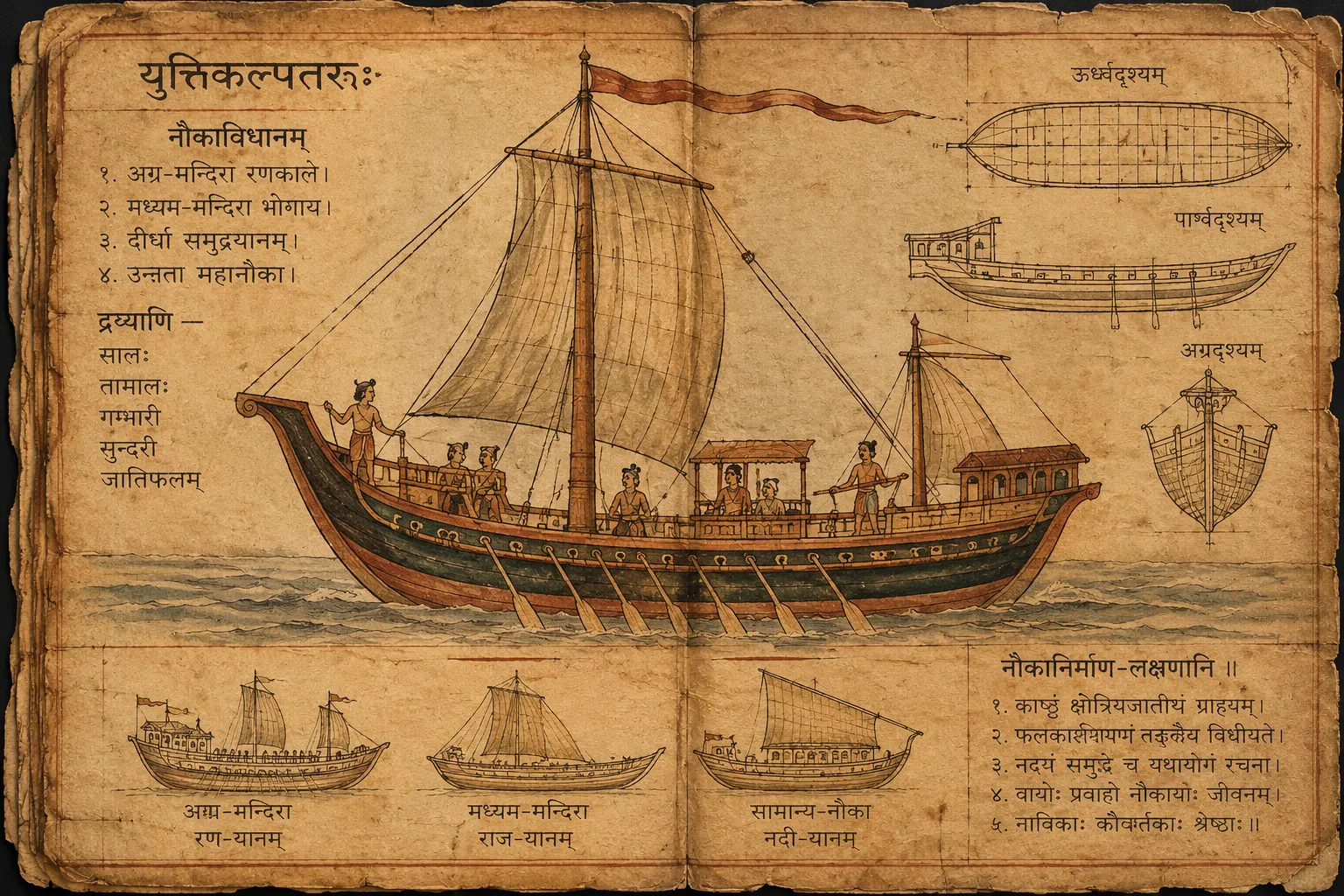
Image disclaimer: The accompanying manuscript-style ship illustration is an imaginative reference image, not an authenticated historical document or a verified reconstruction of a specific ancient Bengali vessel.
A ship, pressed into clay
Some of the most evocative clues come from Chandraketugarh, an archaeological site in present-day West Bengal. Terracotta objects associated with the site preserve images of ships, offering a rare visual record of vessels from Bengal’s ancient past.
A ship depicted on a seal or plaque can reveal details that a written reference may not: the outline of a hull, the presence of a mast, the arrangement of sails or oars, and perhaps figures aboard the vessel. These details give researchers something tangible to examine. They can compare repeated features, ask whether different images represent different kinds of craft, and consider what the depictions suggest about life on the waterways.
But the clay image is not a shipyard drawing. An artist might simplify the hull, enlarge a mast to make it recognizable, or omit structural features that were unimportant to the scene. Even a carefully rendered vessel cannot tell us automatically how its planks were joined, how deep it sat in the water, or how it behaved under sail.
The image gives us a point of departure—not a complete blueprint.
The name of a ship is not the ship itself
Written sources offer another kind of clue. The Periplus of the Erythraean Sea, a Greek-language maritime guide from the first century CE, refers to a vessel called the trapyaka, associated in the research with Bengal’s maritime world and Chandraketugarh’s ship imagery.
Connecting a word in a text to an image is potentially valuable. If the identification is sound, it may help researchers move from a picture of an unfamiliar craft toward a more specific understanding of its role and form.
Yet such a connection needs care. A name may refer to a vessel type, a regional term or a category whose meaning changed over time. An image that resembles a textual description does not prove that the two refer to the same craft.
The research associates trapyaka vessels with features such as a single mast, long oars and a raked stern. These are useful possibilities to investigate, but they should not be presented as a universally established design for ancient Bengali ships. The reconstruction depends on how securely the text, image and geographical context can be linked.
A ship’s name may open a door. It does not remove the need to examine what lies behind it.
What a technical text can—and cannot—tell us
The Yukti Kalpataru, a Sanskrit technical text associated with King Bhoja of Malwa, provides a wider vocabulary for thinking about premodern shipbuilding. It classifies vessels and discusses aspects of their construction, including distinctions between types of ships and the properties of different woods.
Among its categories are Agramandira, associated in the research with warships, and Madhyamandira, vessels described with cabins amidships and linked to transport or command functions. Such descriptions invite questions about how purpose shaped a ship’s size, arrangement and design.
But the text was not written as a manual specifically for Bengal’s shipbuilders. Its categories cannot simply be transferred to every vessel represented in Bengal’s archaeological record. It is evidence for a broader technical tradition, not direct proof that a particular ship from Chandraketugarh—or a Pala-era warship—matched one of its descriptions.
This is where reconstruction becomes a process of comparison. A researcher can ask whether a feature visible in a Bengal image is consistent with a design described in the text. The researcher must still distinguish consistency from proof.
The hidden architecture of a wooden hull
The most difficult parts of a ship to reconstruct may be the ones that an image does not show at all.
A terracotta vessel might reveal the outline of its hull, but not the joints holding the planks together. It cannot show how the builder sealed the seams, how timber was selected, how damage was repaired or how the vessel was balanced for its intended waters. These decisions shaped the ship just as surely as its visible silhouette.
The research discusses sewn-plank construction, in which planks are joined using cordage rather than relying exclusively on iron fastenings. It also considers timber choices and the possible advantages of flexible construction in a landscape of shifting channels, shallow stretches and muddy banks.
Such techniques offer a way to think about the relationship between shipbuilding and environment. A vessel designed for riverine conditions faced different demands from one intended for extended sea travel. But a general account of a construction tradition cannot establish that every ancient Bengali ship used the same method, wood or fastening system.
The reconstruction must therefore proceed feature by feature. What is visible? What is described? What is supported by regional evidence? And what remains a technically plausible hypothesis?
Three layers of a historical ship
A useful reconstruction keeps these questions separate.
First comes the surviving evidence: the shape represented on a terracotta object, the wording of a text, or a securely identified archaeological feature.
Next comes inference: the attempt to explain how those features might have worked together. A hull’s shape may suggest a particular use; a described construction method may help explain how a vessel could be built. Such conclusions gain strength when independent clues support one another.
Finally comes the unknown: details that the evidence cannot settle. The precise dimensions of a vessel, the exact arrangement of its rigging, or the construction of a specific hull may remain uncertain even when the broad form is reasonably understood.
A polished illustration can hide these distinctions. A responsible reconstruction makes them part of the work. Its purpose is not to fill every blank with convincing detail, but to show which details are grounded and which are provisional.
Bringing Bengal’s lost ships back into view
The ships of ancient Bengal will not return as complete objects simply because we want to see them. Their recovery depends on patient work across different kinds of evidence: archaeology, visual interpretation, textual study, technical comparison and the geography of the waterways themselves.
Chandraketugarh’s terracottas offer glimpses of vessels. Texts preserve names and classifications. Technical traditions suggest how wooden ships could be assembled. None of these sources, alone, gives us the whole ship. Together, carefully compared, they can narrow the distance between a surviving trace and a reasoned reconstruction.
That is what makes the task so revealing. The historian is not merely drawing a boat; the historian is testing how far the evidence can carry us into a world whose material objects have disappeared.
A vanished ship can still be studied—but the most honest reconstruction is not the one with the most detail. It is the one that lets us see both the vessel the evidence supports and the uncertainty that remains.