
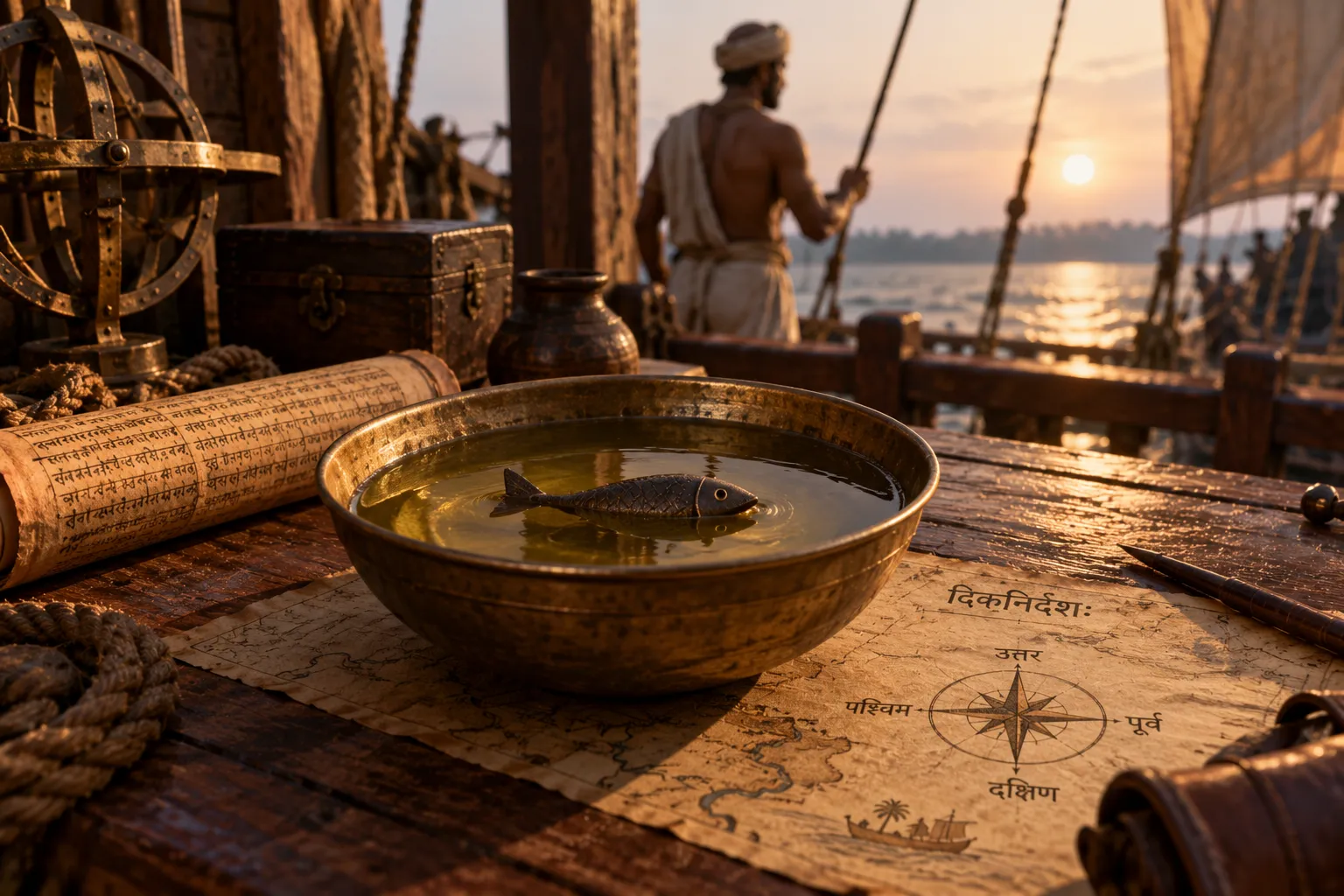
The Fish That Pointed North
A fish floating in a bowl of oil may not sound like a piece of navigation equipment. Yet one of the most intriguing claims in the history of Indian maritime technology describes almost exactly that: an iron fish that could indicate direction.
The device is called the Maccha Yantra—literally, the “fish instrument”. Later descriptions and modern retellings have presented it as a kind of mariner’s compass, suggesting that sailors could use it to find their direction even when land had disappeared from view.
But there is a problem.
How certain are we that the Maccha Yantra was actually a compass, and what does the evidence really establish?
The fish in the oil
The research material describes the Maccha Yantra as an iron fish floating in a vessel of oil. The fish was said to align itself with the Earth’s magnetic poles, providing a directional reference for sailors.
If that description is accurate, the basic principle is fascinating. A magnetised piece of iron can respond to the Earth’s magnetic field, and a freely suspended magnetic object can indicate a consistent direction.
The unusual part is the form.
Instead of a needle, the instrument was imagined as a fish.
That does not necessarily make it less sophisticated. A directional device does not have to resemble the modern compass to perform a related function. What matters is whether the object could reliably orient itself and whether sailors actually used it for navigation.
And that is where the historical question becomes more complicated.
A compass—or a claim about a compass?
The Maccha Yantra appears in the research as part of the technological world surrounding the Yukti Kalpataru, a Sanskrit treatise on shipbuilding traditionally attributed to King Bhoja of Malwa.
The research uses this evidence to connect the device with maritime navigation and to suggest that it could have helped sailors navigate away from the coast.
But the Yukti Kalpataru is not a Bengal-specific manual. It belongs to a wider Indian technical tradition, and the surviving evidence does not allow us to say that every Bengali sailor possessed such an instrument.
That distinction matters.
There is a considerable difference between saying “an Indian technical tradition describes a directional device” and saying “medieval Bengali sailors routinely navigated the open ocean with compasses.”
The first is supported by the research material. The second requires evidence that goes beyond what we currently have.
Why the idea is plausible
The concept itself is not implausible.
Long-distance sailors had a practical reason to care about direction. Coastal navigation can rely heavily on landmarks, river mouths, islands and familiar shorelines. Once a vessel moves farther from land, those references become less useful.
A directional instrument could therefore be extremely valuable.
The research connects the Maccha Yantra with Bengal’s wider maritime world, including the long-distance connections associated with the Pala period. It is tempting to place the device directly into that story and imagine Bengali sailors steering confidently across the Bay of Bengal with an iron fish beside them.
But historical reconstruction has to resist that temptation.
Possibility is not the same thing as proof.
What would we need to know?
To establish the Maccha Yantra as a working maritime compass, several questions would have to be answered.
Was the iron fish deliberately magnetised?
Was it suspended or floated in a way that allowed it to turn freely?
Did the device indicate a consistent direction?
Was that direction actually used by sailors rather than described only as a technical curiosity?
And, most importantly, do we have independent evidence connecting the instrument to Bengal’s sailors and ships?
The research dossier gives a confident answer to these questions, but the underlying evidence presented in it is thinner than the conclusion. Its description of the Maccha Yantra is clear; its claim about widespread Bengali use is much harder to demonstrate.
That does not make the device uninteresting.
It makes the device more interesting as a historical mystery.
The missing instrument
There is another problem with technologies made from simple materials: they leave remarkably little behind.
An iron object can corrode. A wooden container disappears. Oil leaves no obvious archaeological signature. A small navigational instrument is unlikely to survive as a monumental archaeological object.
That means we should not expect to find a beautifully preserved ancient “Bengali compass” waiting in a museum.
Instead, the evidence has to be assembled from texts, terminology, archaeological context and comparison with other navigational traditions.
This is also why the story of the Maccha Yantra should not be separated from the larger history of Indian Ocean technology. Ideas about navigation did not develop inside sealed regional compartments. Sailors, shipbuilders and technical traditions moved across the same maritime world as merchants and religious travellers.
What the fish tells us
Even if we remain cautious about calling the Maccha Yantra a fully developed compass, the idea behind it reveals something important about the technological imagination of the period.
Someone had conceived of a device in which an iron object could provide directional information.
That is already a remarkable thought.
But history becomes stronger, not weaker, when we preserve the uncertainty around it. We do not need to turn every intriguing technical description into proof of a lost age of scientific perfection.
The surviving evidence gives us a device, a description and a tantalising possibility.
It does not yet give us a complete story of how Bengali sailors used it at sea.
So, did the fish point north?
Perhaps.
The Maccha Yantra may preserve an early understanding of magnetic direction, and its description is compatible with the basic principle of a magnetic directional instrument. But the evidence available in the research does not justify confidently reconstructing it as a standard navigational compass used routinely by Bengal’s medieval fleet.
That uncertainty is not a failure of the story.
It is the story.
Ancient technologies often survive not as complete machines but as fragments of language, descriptions and ideas. Somewhere between those fragments and the modern imagination lies the historian’s real task: determining what can be recovered, what can reasonably be inferred, and what must remain an open question.
For now, the little iron fish belongs in that last category.
It may have pointed north. The evidence, however, still leaves us asking exactly how—and for whom.