
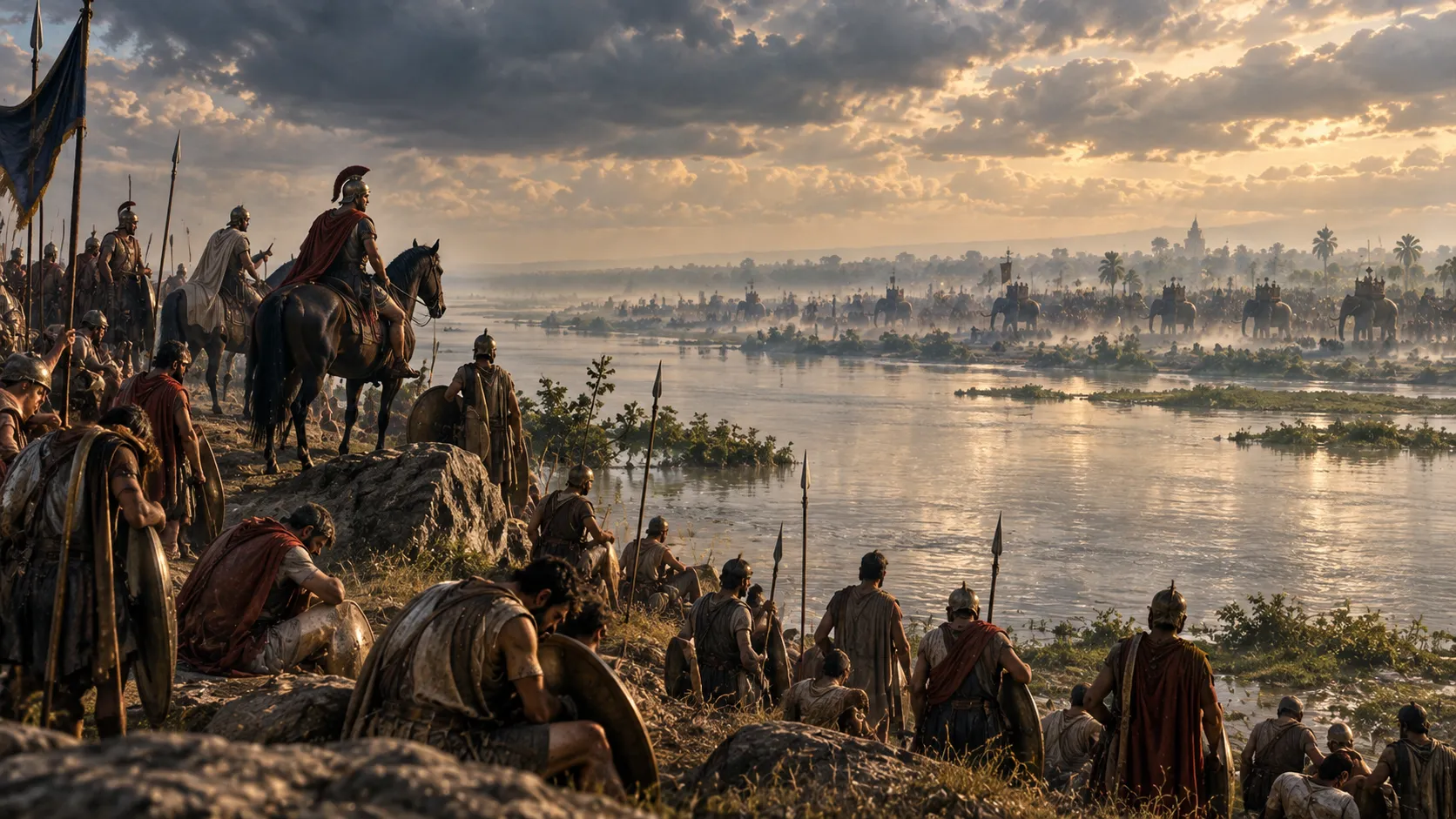
Why Alexander Never Reached Bengal
Alexander’s army had travelled farther east than any Macedonian army before it. By 326 BCE, it had crossed the Indus, defeated King Porus at the Hydaspes and continued through the northwestern regions of the Indian subcontinent. Yet the campaign stopped at the Hyphasis, generally identified with the Beas River. The Ganges and the kingdoms farther east remained beyond Alexander’s reach.
This has often been turned into a simple heroic story: Alexander came to India, heard about the mighty Gangaridai of Bengal, and was so frightened that he turned back.
The historical record is more complicated.
Alexander never fought the Gangaridai. No surviving source describes a battle between Alexander’s army and a Bengali army. The Macedonian troops refused to continue at the Hyphasis, before they had reached the Ganges. Their exhaustion, the enormous distance from home, the difficulties of continued campaigning and the prospect of confronting powerful kingdoms farther east all formed part of the decision.
Yet the Gangaridai still occupy an extraordinary place in the story. Greek writers repeatedly associated them with the Ganges and with an enormous force of war elephants. Reports about these eastern powers reached Alexander’s army before Alexander himself did. The question, then, is not whether Bengal defeated Alexander in battle, but why the prospect of going farther east had become so daunting to an army that had already conquered much of the known world.
The Campaign That Kept Moving East
Alexander’s expedition had begun in Macedonia and transformed into something far larger than the invasion originally undertaken against the Persian Empire. After defeating the Achaemenid forces and occupying Persia, Alexander continued through Central Asia and eventually crossed into the Indian subcontinent.
The campaign in India was difficult from the beginning.
The Macedonians encountered unfamiliar political systems, unfamiliar climates and military forces unlike those they had fought in the western parts of Alexander’s empire. Among the most formidable were war elephants. At the Hydaspes, King Porus deployed elephants alongside his infantry, forcing Alexander’s army to confront one of the most difficult battlefield problems it had yet encountered.
Alexander won that battle.
But victory did not mean that the eastern campaign had become easy. The army still had to cross rivers, maintain its supply lines and continue into territories about which Macedonian soldiers possessed increasingly uncertain information.
After the Hydaspes, Alexander wanted to move farther east. His soldiers, however, had been campaigning for years and were increasingly unwilling to continue. When the army reached the Hyphasis, their resistance became decisive.
The expedition had reached a limit.
The interesting question is what lay beyond that limit.
Beyond the Hyphasis
The Hyphasis was not the Ganges.
This is one of the most important distinctions in the entire story.
Alexander’s army stopped at the Hyphasis in the Punjab. The Ganges lay much farther east, beyond territories the Macedonians had not conquered. The Gangaridai were associated by Greek writers with the eastern Gangetic world, and their reputation formed part of the information reaching Alexander’s army about what awaited beyond the frontier it had reached.
The research materials emphasize the scale attributed to the Ganges in Greek accounts and the formidable reputation of the Gangaridai. Diodorus describes the river as extraordinarily wide and associates the Gangaridai with an immense elephant force.
For soldiers who had already fought one major battle involving elephants, such reports were hardly trivial.
The precise numbers should be treated cautiously. Ancient writers were dependent upon reports from travellers, soldiers and intermediaries, and the figures they preserved cannot simply be treated as modern military statistics. What matters more securely is the consistency of the image: the powers farther east were represented as formidable, and their elephant forces were portrayed on a scale that impressed or alarmed Greek observers.
The eastern frontier had acquired a reputation before Alexander reached it.
The Memory of Porus
The Battle of the Hydaspes helps explain why reports about the Gangaridai could have mattered so much.
Porus had already demonstrated what an Indian army equipped with elephants could do. Alexander’s forces eventually overcame him, but the battle was difficult, and the Macedonians had to adapt their tactics to a battlefield dominated by elephants and a major river crossing.
The soldiers therefore knew that elephants were not simply exotic animals encountered in distant lands. They were serious military weapons.
When reports suggested that the powers beyond the Ganges possessed elephants in vastly greater numbers, the information had to be considered against the soldiers’ own experience.
The research materials repeatedly emphasize this psychological dimension. Diodorus, Curtius and Plutarch all preserve traditions presenting the Gangaridai and associated eastern powers as militarily formidable, while reports of their elephants contributed to the reluctance of Alexander’s army to continue eastward.
That does not prove that the Gangaridai alone caused the mutiny.
It does suggest that the eastern kingdoms formed part of the strategic calculation confronting Alexander and his soldiers.
A River Larger Than the Rivers They Had Known
The reports about the Gangaridai contained another intimidating element: the Ganges itself.
Alexander’s army had already learned that rivers could become formidable military obstacles. Crossing a major river under hostile conditions required reconnaissance, deception, engineering and careful coordination. A river crossing exposed troops at precisely the moment when they were most vulnerable.
The research describes the Ganges associated with the Gangaridai as an exceptionally large waterway and emphasizes the difficulties its size and surrounding deltaic environment could create for an army approaching from the west.
The point should not be exaggerated. There is no surviving account describing Alexander actually attempting to cross the Ganges against the Gangaridai.
But the psychological effect of the reports is easier to understand when viewed through the experience of the campaign.
The Macedonians were not being asked merely to march another few hundred kilometres. They were being asked to continue into a region containing another enormous river, unfamiliar political powers and reports of exceptionally large armies, after years of campaigning far from home.
The calculation was becoming increasingly unattractive.
Was Bengal’s Geography Part of the Deterrent?
This is where the story connects with the broader question of Bengal’s riverine military history.
The Gangaridai were associated with the lower Ganges region, a landscape of distributaries, wetlands, marshes and waterways. The research argues that such geography could have provided substantial defensive advantages to a population familiar with it, particularly against armies dependent upon cavalry and large formations.
That argument is historically plausible, but the evidence has limits.
We cannot reconstruct a complete Gangaridai battle plan from the surviving Greek sources. The research’s more elaborate descriptions of river patrols, coordinated elephant forces, fortified crossings and attacks on enemy logistics are interpretations rather than directly documented operations.
This distinction is especially important when discussing Alexander.
He never reached the Bengal delta.
Therefore, any claim that a specific Gangaridai river-defense system defeated or physically repelled Alexander goes beyond what the sources establish.
What we can say is that the geographical and military reputation of the eastern Gangetic world contributed to the sense that continuing eastward would involve another enormous military undertaking.
The Gangaridai Were Real. The Full Story We Tell About Them Is Harder to Prove.
The Gangaridai are not simply a legendary invention created much later.
They appear in ancient Greek geographical and historical traditions, and those accounts consistently associate them with the Ganges and with substantial military power. Diodorus, Curtius and Plutarch preserve traditions concerning the eastern peoples encountered in Alexander’s world of information.
But the sources do not give us everything we would like to know.
We do not have a detailed Gangaridai military archive. We do not have a surviving account written by a Gangaridai commander describing the kingdom’s strategy. We do not have a battlefield report explaining how its forces would have confronted Alexander.
This creates a temptation to fill the gaps.
The research materials do exactly that in places, proposing a sophisticated riverine defense in which elephant forces operated from muddy banks while light boats attacked enemy logistics.
Such a reconstruction can help us think about how the geography might have affected warfare, but it should remain clearly identified as reconstruction.
The distinction between what the sources say and what historians infer from them is essential.
The Soldiers Had Their Own Reasons
Even without the Gangaridai, Alexander’s army had powerful reasons to stop.
The soldiers had been away from home for years. They had fought repeated campaigns and travelled enormous distances. Many had accumulated wealth, but they had also endured hardship, casualties and exhaustion.
Alexander’s ambitions did not necessarily correspond with the soldiers’ willingness to continue.
The army had already defeated Porus and crossed the Hydaspes. The prospect of another campaign farther east therefore required the soldiers to accept not merely another battle but an indefinite continuation of the expedition.
The reports about the Gangaridai and the Prasii made that prospect still more intimidating.
Ancient sources should not be read as though Alexander received a single intelligence report saying, “There are 4,000 elephants, therefore retreat.”
Military decisions rarely work that way.
The information about the eastern powers was one element in a much larger calculation involving morale, logistics, distance and the expected cost of another campaign.
The Power of a Reputation
This is perhaps the most interesting part of the story.
A state does not have to fight an enemy to influence its decisions. Sometimes the reputation of its strength is enough to change the calculation.
The Gangaridai had acquired such a reputation in the Greek accounts. Their association with the Ganges, their reported elephant forces and their position at the eastern edge of Alexander’s campaign made them a powerful presence in the imagination of soldiers who had never seen them.
The research describes this as a form of psychological deterrence.
The word “deterrence” needs to be used carefully here because it can suggest an intentional diplomatic strategy for which we do not have direct evidence. But as a description of the effect of reputation, it is useful.
The soldiers knew that something formidable was believed to exist farther east. They knew they would have to reach it before they could fight it. And they knew that reaching it would require continuing a campaign they were already unwilling to continue.
Alexander Had Not Been Defeated
This point deserves emphasis because it separates history from legend.
Alexander did not retreat from Bengal after losing a battle. He did not meet a Gangaridai army on the Ganges. He did not fight a Bengali navy.
The Macedonian army stopped at the Hyphasis because the soldiers refused to advance farther. The Gangaridai were beyond the territory Alexander had reached, and the surviving evidence does not permit us to say that they directly forced him from the field.
Yet it would also be wrong to conclude that Bengal had nothing to do with the story.
The eastern kingdoms were part of the information environment surrounding the army’s decision. Reports about the enormous forces beyond the Ganges contributed to the perceived difficulty of continuing eastward, even though they were not the sole reason for the army’s refusal.
That is a more complicated story than “Alexander was defeated by Bengal.” It is also a more defensible one.
What the Ganges Meant to an Army From the West
For Alexander’s soldiers, the Ganges represented more than another river.
It marked the edge of a geographical and political world they had not yet entered.
The research emphasizes the contrast between the Macedonian military system and the deltaic environment farther east. Cavalry and heavy formations were most effective under conditions that allowed them to maneuver, while the rivers and wetlands of Bengal created a very different military environment.
Again, this should not be converted into a claim that Bengal was an unconquerable natural fortress.
History does not support that.
Bengal was invaded many times. Its kingdoms rose and fell. Its rulers lost battles.
The significance of the landscape was instead that it could alter the cost and difficulty of military operations. An army entering such a region had to adapt to conditions that were familiar to local populations but unfamiliar to outsiders.
That distinction would remain important in Bengal’s military history long after Alexander’s campaign had disappeared into the past.
The Frontier Alexander Left Uncrossed
Alexander eventually turned back. His army retraced its path westward, while Alexander himself continued to pursue further ambitions for a time. The expedition that had begun at the opposite end of the ancient world had reached a geographical limit that its soldiers would not cross.
The Ganges remained beyond them. So did the Gangaridai.
That fact has generated centuries of speculation because the eastern horizon of Alexander’s campaign is one of those places where history and possibility meet. We know the names of the peoples he had not yet encountered. We know the reports about their armies. We know the scale of the river that stood between them and the western campaign. But we do not know exactly what would have happened had Alexander’s soldiers agreed to continue.
Perhaps they would have won. Perhaps they would have suffered another difficult campaign and eventually prevailed. Perhaps the eastern powers would have resisted successfully.
The surviving evidence cannot answer the question.
And that uncertainty is precisely what makes the story worth preserving.
Bengal’s Victory Was Not a Battle
There is a temptation in historical storytelling to look for a victorious army and a defeated army.
Alexander’s eastern campaign does not give us that neat ending.
The Macedonians stopped before reaching Bengal. The Gangaridai did not defeat them in combat. Yet the eastern powers were sufficiently formidable in the reports reaching Alexander’s camp to become part of the perceived danger of continuing.
The distinction matters because it changes how we understand power.
A kingdom’s strength does not exist only in the battles it fights. It can also exist in the cost that an opponent expects to pay before a battle even begins.
The Gangaridai’s reputation, whether every detail reported by Greek writers was accurate or not, had become part of that calculation.
The Ganges represented distance. The elephants represented military strength. The eastern kingdoms represented uncertainty. And Alexander’s own soldiers represented the final limit.
Together, these factors made the road farther east increasingly difficult to justify.
The Boundary of Alexander’s World
Alexander’s campaign is often remembered as an almost uninterrupted sequence of victories until the moment his army suddenly turned around.
The story is more revealing when we see the limits accumulating.
He could defeat armies, but he could not eliminate distance. He could cross rivers, but every new river required another operation. He could conquer kingdoms, but each new kingdom created another political problem. He could command his soldiers, but he could not make exhausted men want to continue indefinitely.
And beyond the Hyphasis stood reports of an eastern world that appeared larger, more populous and more heavily equipped with elephants than anything they had yet faced.
The Gangaridai belonged to that world.
Alexander never discovered for himself how accurate the reports were. His army decided that it had travelled far enough.
What Actually Stopped Alexander?
The most honest answer is not a single thing.
Alexander was stopped by the refusal of his army at the Hyphasis. That refusal had deep roots in exhaustion, distance, accumulated campaigning and the soldiers’ desire to return home. At the same time, the prospect of confronting powerful kingdoms farther east, associated in Greek accounts with the Ganges and enormous elephant forces, made continuing the expedition less attractive.
The Gangaridai therefore belong to the story as a power beyond the frontier, not as an army that defeated Alexander on a battlefield.
Their geographical position mattered. Their military reputation mattered. The Ganges mattered. The reports reaching Alexander’s soldiers mattered.
But the final decision was made by the men who had marched with Alexander all the way to the Beas.
They had reached their limit before the Ganges.
The Bengal Alexander Never Saw
That may be the most remarkable part of the story.
Alexander conquered cities he had never imagined seeing when he left Macedonia. He crossed mountains and rivers that had existed outside the experience of the armies that followed him. He defeated kings who had seemed powerful until they met his army.
But there was one eastern frontier he never crossed.
The Gangaridai remained a name in the reports. The Ganges remained a river beyond the campaign. Bengal remained a country Alexander never entered.
We cannot know whether he would have conquered it. We cannot know whether the Gangaridai could have defeated him.
What we can know is that by the time Alexander’s army stood at the Hyphasis, the eastern world had already acquired a formidable reputation. The soldiers had heard of the great river and the enormous armies beyond it, and they had no desire to discover whether those reports were true.
Alexander had spent years proving that his army could overcome almost any obstacle placed directly in its path.
At the Hyphasis, the obstacle was different.
It was the decision to keep going.
And this time, his army said no.