
Before Sandesh: What Sweetened Bengal a Thousand Years Ago
A king’s copperplate is an odd place to begin a sweets story. Dharmapala, whose reign is placed roughly between 781 and 821 CE, issued the Khalimpur land grant a little before the high Pala window that concerns this series—about 900 to 1100 CE. The inscription is administrative, not culinary: villages, boundaries, produce, the paperwork of patronage. Historian Niharranjan Roy, reading that corpus for what a landscape once held, noted date palms among what the plate records. A tree named in a grant is not a jar of jaggery on a table. It is, however, Bengal-specific and direct: the date palm was already part of the regional agrarian vocabulary before the centuries we are asking about.
Then jump forward past those centuries. In 1205 CE—roughly a hundred years after the window closes—Sridharadasa compiled the Sanskrit anthology Kāvya Saduktikarnāmrta. Roy identified in it a reference to nolen gur, the soft, seasonal form of date-palm jaggery that later Bengali winters still treat as a kind of edible weather. The anthology date is post-window; as an anthology it may preserve earlier verses, but the citation itself should be handled as a strong, carefully dated inference rather than a recipe from 950 CE. What matters for the argument is the bracket. Date palms before the Pala peak; nolen gur named just after it. Continuous cultivation of the crop through 900–1100 CE is not a single in-window document. It is a very reasonable strong inference from two real Bengal-facing citations that refuse to let the tree disappear in the middle.
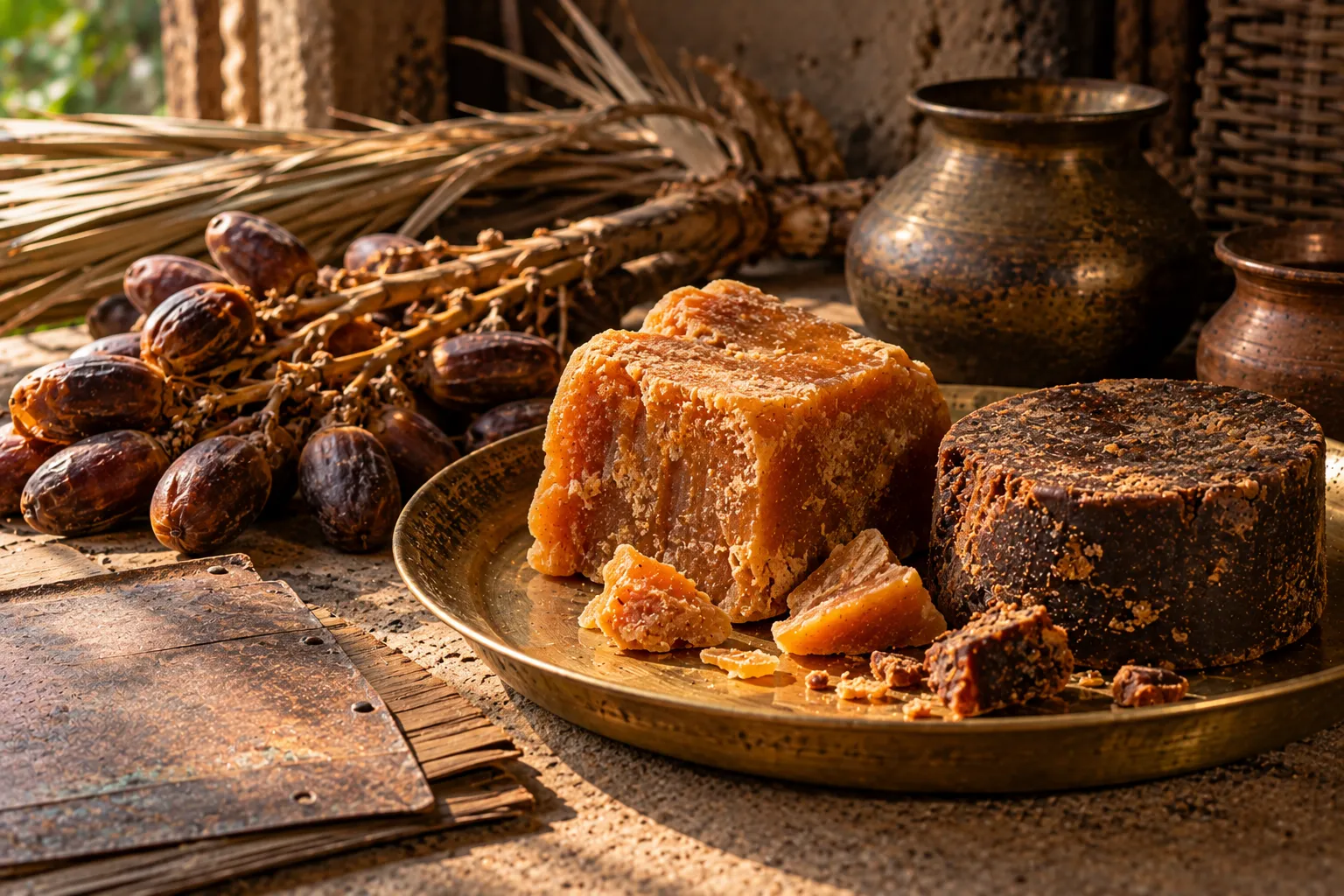
Secondary literature sometimes speaks of palm-sugar production as a village industry with millennia of regional history. That longer figure is a broad traditional estimate, not a citation this research can hand to a particular ancient source, and it should stay in the background. The usable claim is narrower and stronger: across the millennium this series is trying to bridge, date-palm jaggery—khejurer gur, including the nolen gur thread—is the sweetener with the clearest Bengal-specific documentary through-line. If something sweetened an early-medieval Bengali plate with local continuity rather than pan-Indian generalisation, the palm is the candidate that survives contact with the footnotes.
The sweets that were not there
That finding sits awkwardly beside Bengali culinary pride—and the awkwardness is the point.
Ask what the world thinks Bengal tastes like after the meal, and the answer arrives almost automatically: sandesh, roshogolla, the soft architecture of chhena sweets. Those forms depend on a technical precondition. Milk must be deliberately curdled with an acid so that a paneer-like curd separates; that curd is then worked, sweetened, shaped. Food historians following K. T. Achaya, and the wider consensus in Bengali sweets historiography, place that curdling technique considerably later than the Pala centuries—in some tellings, after Portuguese-era or early-modern dairy diffusion. No evidence of any kind for chhena-based sweets in 900–1100 CE Bengal was located for the research behind this series. Their absence should be treated as close to certain—a direct negative—not as a polite gap waiting to be filled by nostalgia.
The implication is mildly comic if you let it be. The sweet Bengal became famous for exporting is not the sweet with the oldest local paperwork. Saying so is not a slight against modern mishti; it is a chronological correction. The sandesh shop is a late triumph of dairy chemistry and urban craft. The palm was already on the copperplate.
Milk itself is a more delicate sentence. Across Sanskrit literary tradition, milk, curd (dadhi) and ghee (ghrita) are among the most textually saturated food categories available—attested from the Vedic corpus onward with a density that makes dairy’s absence from Indian agrarian life almost harder to imagine than its presence. Cattle-keeping is a basic feature of that world. For Pala Bengal specifically, however, no 900–1100 CE Bengal-dated inscription or text naming milk, curd or ghee in a local kitchen was located for this series. The honest position is civilisational inference at strength, not local proof: dairy in some form in an agrarian Bengal household of this period is strongly plausible by the weight of the wider tradition; it is not a citation you can point to on a map of the delta and date to this century. Butter as a separately named product, rather than a stage toward ghee, is thinner still—plausible at most.
From that hedged dairy, and from rice and a sweetener that are independently better attested, a simple cooked rice-and-milk-and-sweetener dish—ancestral in spirit to modern payesh—becomes plausible at the level of ingredients. The named modern dish should not be projected backward. Proto-payesh is a reconstruction of possibility, not a recovered recipe title. Bengalis a thousand years ago were not without sweetness, and they were not necessarily without milk. They were without the particular curdling technique that later made the soft white sweets possible.
Other sweetness, thinner proof
If the palm holds the strongest Bengal-specific claim, what else might have sweetened the plate?
Sugarcane and its processed or fermented derivatives carry deep weight in early-medieval Indian textual tradition. Sidhu—a sugarcane-derived fermented drink, sometimes rendered as sugarcane “wine”—appears as a named beverage category in scholarly treatments of ancient and early-medieval India, including work published in History of Science in South Asia. That is general Indian evidence. The sources used for this series did not confirm sidhu, or sugarcane sweetness more broadly, as Bengal-specific inside the 900–1100 CE window. Treat cane sugar and cane drink as strong inference for the wider Sanskrit-literate world, not as a dated Bengal pantry list.
Honey is older still as a human habit: wild honey-collection is ancient and pan-Indian. No Bengal-specific tenth-century citation was located. Plausible, unanchored, easy to overstate. It belongs in the picture as atmosphere, not as a proven local staple of the century.
None of these thinner threads cancel the palm. They thicken the sense that sweetness was available—by tree, by cane somewhere in the wider economy, perhaps by hive—without licensing a modern sweetmeat menu. The early-medieval plate could be sweet. It almost certainly was not sweet in the ways a contemporary mishti catalogue trains the tongue to expect.
None of this requires a dramatised winter kitchen, with sap boiling in a pot we have not excavated. The point is documentary, not scenic: the palm is bracketed; the famous milk-sweets are not. Winter nolen gur on a modern table may still taste like continuity. The paperwork that can actually be cited for continuity points at the tree and the jaggery, not at the chhena mould.
Put the chronology side by side and the discovery sharpens. Before the window: date palms in Dharmapala’s Khalimpur grant. Through the window: continuous palm cultivation as strong inference, dairy as civilisational inference without a Bengal-period citation, cane and honey as general or merely plausible. After the window: nolen gur named in Saduktikarnāmrta. Much later still: the chhena technique that underwrites sandesh and roshogolla, placed by food-historical consensus well after Pala Bengal. The famous milk-sweets are late. The palm is old. The pride that treats the former as timeless Bengal and the latter as a seasonal specialty has the ages almost backwards.
That does not diminish sandesh. It relocates it. A craft can become identity in a few hundred years; cities, markets and technique are efficient that way. What it cannot honestly borrow is the antiquity of the date palm already written into a land grant before the Pala peak, or of the jaggery named in an anthology as the next century opened. The strongest continuous Bengali sweetener claim across this millennium is not the white sweet the world ordered in a box. It is the dark, seasonal yield of a tree a king’s scribe had reason to mention—and a poet’s compiler, much later, still knew by taste.