
The Spice Mix That May Be Much Younger Than Bengal
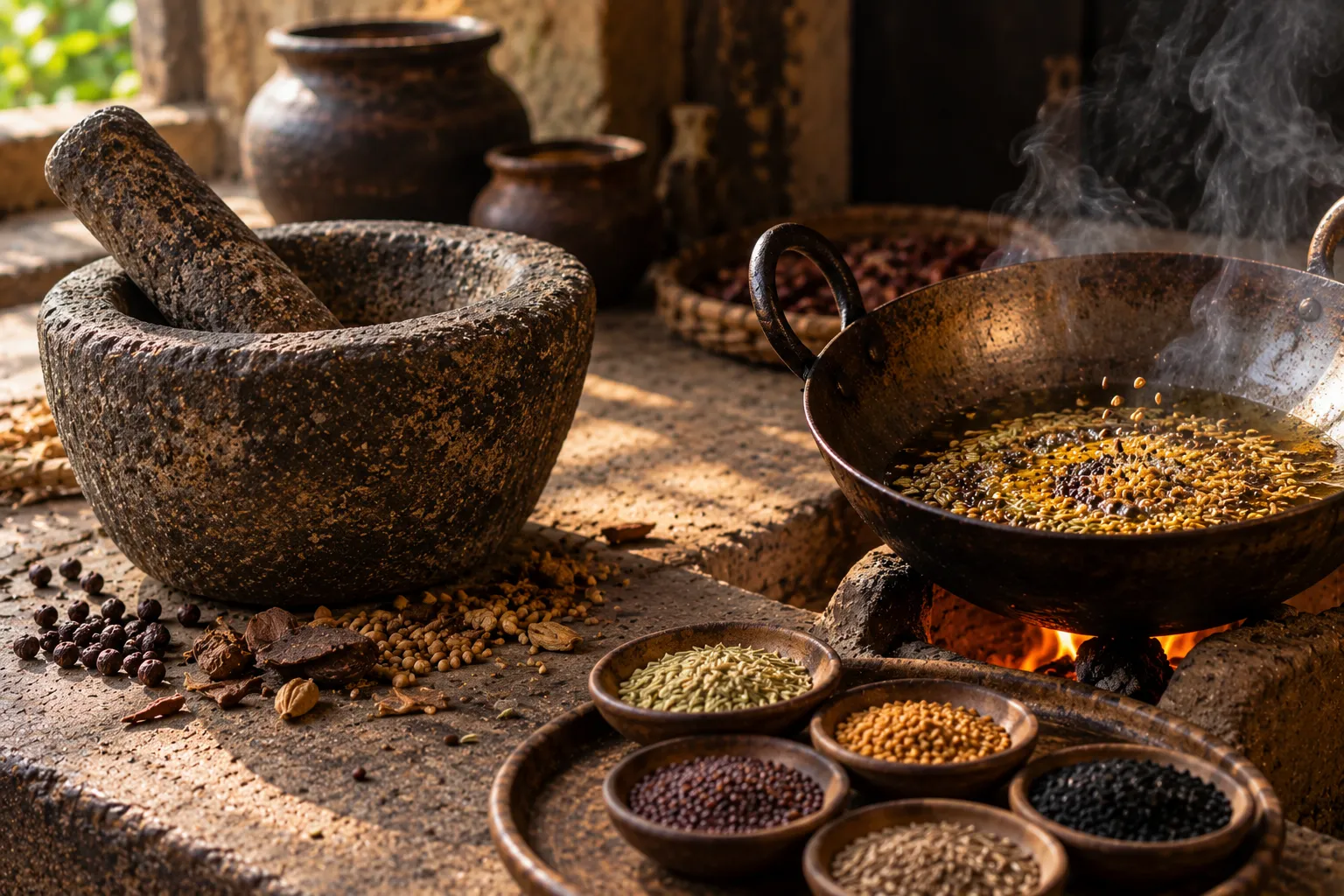
Hear it before you can name it: a small fist of seeds hitting hot mustard oil, the brief furious crackle, then that perfume—warm, slightly bitter, faintly sweet—settling over a kitchen the way a signature settles over a letter. In modern Bengali cooking, that signature has a name. Panch phoron: five spices, thrown whole into fat at the start of a dish, a tempering so familiar that many eaters treat it as the smell of Bengal itself.
Step back into the high Pala period—roughly 900–1100 CE—and the chronological doubt begins. No Bengal source from that window describing tempering, a spice paste as codified practice, or anything resembling the standardised five-spice mix was located for this series. The honest recommendation is blunt: treat panch phoron, and named tempering/tadka as a culinary ritual, as a considerably later codification—likely early-modern or colonial-period—rather than Pala practice. The perfume many of us treat as ancestral may be a later invention. That is the story.
Five seeds, one name
For readers outside Bengal, the mix is simple enough to hold in the hand. Panch phoron typically gathers five whole spices—commonly fenugreek, nigella (kalonji), cumin, fennel and mustard seed, with small regional substitutions—kept unground and bloomed in hot oil or ghee. The method is as important as the list: not a powdered curry blend stirred through a gravy, but a brief, audible tempering that announces the dish before the first bite. In Bengali kitchens today, that crackle often is the beginning of flavour.
What turns up is not a rival recipe. It is an absence. No 900–1100 CE Bengal text, inscription or excavated assemblage was located that names this five-seed combination, describes a tempering technique, or treats spice-grinding-into-paste as a codified kitchen ritual of the kind modern cooks recognise. The confident modern claim—“they cooked with mustard oil, panch phoron, and a bit of chilli for heat”—fails twice: chilli is a five-to-six-century anachronism owned by another story in this series, and panch phoron as a standardised mixture has no located period evidence at all. Silence is not proof that no one ever tossed a seed into fat. It is proof that the named, standardised blend we now treat as timeless has not been found near this century—and should not be projected backward as Pala fact.
Old stones, unnamed ritual
Here the argument must hold two truths at once, or it collapses into a softer myth.
Grinding technology in this region is old. A terracotta plaque from Chandraketugarh, in the West Bengal delta, dated to the second century BCE—well before the Pala window—shows two women standing at a mortar placed between them, each with a long pestle. The scene is gendered, domestic and unmistakably about pounding. It is discussed in the iconographic survey “A Glimpse of the Grinding and Pounding Tools in Early Indian Art” (Heritage University of Kerala Journal 11.2), which places the plaque inside a much longer pan-Indian visual tradition of grinding and pounding. For the second century BCE, the evidence is direct. That the same simple technology persisted through 900–1100 CE is a strong inference from durability and continuity, not a continuous documentary film of every century’s kitchen labour.
That capacity matters—and it does not settle the blend. A mortar can crush grain, pound spice, or make a paste. It cannot, by itself, invent a named five-spice tempering ritual. The distinction is explicit: physical capacity to grind spices into a paste existed long before and through the Pala period; a specific standardised tempering practice remains unproven for that window and is a likely anachronistic projection if assumed simply because stones existed. Old capacity, young ritual. The stones are ancestral. The named phoron is the problem.
Spices without a recipe
Strip the blend apart, and the picture changes again.
Individual spices that now sit inside or beside Bengali cooking—ginger, turmeric, cumin, coriander, fenugreek, black pepper, long pepper, garlic—carry deep pan-Indian antiquity. They appear in the classical Ayurvedic corpus associated with the Charaka Samhita and Sushruta Samhita traditions, compiled and redacted over the early centuries CE, well before the Pala window, under Sanskrit names such as ardraka, haridra, jiraka, dhanyaka, methika, maricha and pippali. Their presence across the wider Sanskrit-literate and trading world by the tenth century is among the better-settled facts in South Asian food history. What this research could not locate is a Bengal-specific 900–1100 CE textual or archaeological citation naming any one of them in a local kitchen context. The honest position is comparative, not excavated: it would be surprising if a Pala-era Bengal kitchen lacked these staples; it would be dishonest to pretend they have been recovered from a dated Bengal hearth.
Mustard and sesame sit on firmer ground as crops. Both appear in the flotation archaeobotany from Vikrampura (Raghurampura) in Bangladesh, studied by Rahman, Cobo Castillo, Murphy, Rahman and Fuller (2020)—a monastic assemblage whose earliest phase overlaps the tail of the 900–1100 CE window. Crop presence is the direct finding; that those seeds were pressed into the cooking oils Bengali cuisine still treats as defining is a strong inference, not an oil residue claim. That oil continuity belongs more fully to the series’ grain-and-fat story. Here it matters only as atmosphere: the fat into which a later cook would throw panch phoron already had deep local roots. The named five-seed ritual thrown into that fat does not.
Chilli, the heat many modern temperings now expect, was simply not in Afro-Eurasia before the Columbian Exchange; its South Asian arrival belongs to the sixteenth century and later. That absence is another story’s spine. Mentioned once, it sharpens this one: even the sensory world that later wrapped itself around panch phoron was still being assembled centuries after Pala Bengal.
When memory outruns the date
Put the pieces together and the paradox is quiet rather than scandalous.
Bengal’s grain, pulse and oil architecture has real depth—rice and dals and mustard–sesame crops that can be argued from soil and inference with unusual honesty. Grinding stones, and the labour of using them, are older still in this delta’s visual record. Individual spices float in from a pan-Indian medical and culinary vocabulary that makes their absence harder to imagine than their presence. None of that equals a dated panch phoron. The named blend, and tempering as a codified technique of the modern kitchen, remain—on present evidence—unknown for Pala Bengal and best treated as later culinary standardisation.
That finding does something gentler than stripping a kitchen of identity. It separates inheritance from invention without sneering at either. A spice mix can become the smell of home in a few hundred years; memory is efficient that way. What it cannot do is borrow the age of the rice beneath it, or of the mortar that could have crushed any seed a cook chose to name. The perfume many treat as ancestral may be younger than Bengal’s grain—a late arrival that learned, thoroughly and deliciously, to pass as the beginning of the dish.
Return to the crackle in hot oil. Listen again. The sound is real; the appetite it wakes is real; the cultural work it does in a modern Bengali kitchen is real. The chronology is what shifts. Capacity to grind spice is not panch phoron. And a blend that feels like forever may, on the evidence we actually have, be one of the ways Bengal taught itself what “forever” should smell like—long after the Pala kitchen had already gone cold.