
What Did Bengali Food Taste Like 1,000 Years Ago?
Picture a familiar Bengali plate. Rice. A yellow dal. A piece of fish in gravy. The faint bite of mustard oil. Then begin the mental experiment: lift away the sharp sting of chilli, the tomato’s bright sour lift, the soft crumb of potato, the perfume of a named five-spice tempering, the post-meal sandesh. What is left on the tongue?
Step back roughly a thousand years—into the high Pala period of Bengal, about 900–1100 CE—and the answer is stranger than nostalgia allows. The plate does not simply become a thinner copy of today’s kitchen. Something older stays. Something most people now recognise as “Bengali flavour” has not yet arrived.
That split is the story. The base layer—grain, pulses, fish, and the oils that still define Bengali cooking—has deep roots in this delta. The flavour culture on top—chilli heat, tomato-based sourness, potato body, standardised spice blends, chhena sweets—is comparatively recent. Neither “nothing has changed” nor “everything has changed” survives contact with the evidence.
The room that will not appear
The first obstacle is almost comic. For all the monasteries, seals, sculpture and ceramics Pala Bengal has surrendered to archaeology, no one has published an ordinary domestic kitchen from this window. Bamboo, timber, thatch and mud do not leave mounds the way brick temples do. Excavation money follows what survives as a hill—Paharpur, Mainamati, Mahasthangarh—so the richest published sites are monastic, religious or administrative. A 2016 survey of western Bengal’s Rarh uplands by Chatterjee and Bhattacharya noted structural remains that were “predominantly religious,” with “hardly any evidences of secular building complexes.” The household cooking space is not so much lost as never designed to be found.
That absence is useful, if you let it be. It stops the reconstruction from pretending to walk into a room. What we can recover is not the look of a Pala kitchen so much as the logic of a Pala meal—and that logic begins with what grew in the soil.
Carbonised wonder: rice and fourteen dals
The closest scientific look we currently have comes from flotation-recovered seeds at Raghurampura in Vikrampura, a Buddhist monastery site in present-day Bangladesh studied by Rahman, Cobo Castillo, Murphy, Rahman and Fuller (2020). The site runs from the eleventh to the sixteenth century, so its earliest phase only overlaps the tail of the 900–1100 CE window, and the assemblage is monastic rather than a village hearth. Those limits matter—and they do not cancel the wonder of what the soil held.
Oryza sativa—rice—dominates. Wider regional synthesis already places rice cultivation in Bengal across millennia; wheat, often smuggled into generic “ancient India” imagery, does not appear as a staple here and should not be assumed for the wet delta. Beside the rice sits a pulse economy of unusual richness: fourteen species, including mung bean, black gram, lentil, chickpea, horsegram and rice bean—the last a first archaeological identification anywhere in South Asia. Dal beside rice is not merely folk memory. At one monastery site, it is carbonised seed.
Mustard and sesame appear in the same record. That matters because mustard oil and sesame oil remain the two defining cooking fats of Bengali cuisine. Crop presence is the direct finding; pressing those seeds specifically into cooking oil is a strong inference rather than a chemically proven residue claim. Still, among the threads from Pala-era fields to a modern plate, this oil continuity is one of the few that can be stated with real weight. The everyday architecture of the meal—grain, pulse, fat—was already in place long before the notes that now advertise “Bengali food.”
Pala-era copperplate land grants describe villages granted with their produce, grounding a rice economy in administrative language rather than nostalgia. The Charyapada—Buddhist tantric verses from roughly the tenth to twelfth centuries, in an eastern Indo-Aryan idiom ancestral to Bengali, Assamese and Odia—preserves scattered food images of rice pots, milking, hunting and wine fermentation. Poets’ regional attributions are contested, but the verses offer continuity colour rather than a recipe book.
Fish, almost certain—and almost invisible
Fish occupies a curious place here. No published fish-bone study from a securely dated early-medieval Bengal domestic or monastic site has yet been located; classic mid-twentieth-century excavations often predated fine-mesh flotation. Yet the Bengal delta, fed by the Ganges–Brahmaputra–Meghna system, is among the most fish-dense environments on earth. Ecological necessity makes fish as a staple close to certain even when bones remain hard to find.
Adjacent evidence strengthens the wider picture without pretending to be a Bengal kitchen find. An eighth-century study by Wang and colleagues of dried and salted rohu (Labeo rohita) transported across Himalayan trade routes places that fish—still central to Bengali food culture—inside the Indo-Gangetic riverine world just before our window. Drying follows as a strong inference in a monsoon flood economy; the modern shutki package should not be projected backward as period fact. No named modern preparation—machher jhol, shorshe maach—has been located for this century. Fish was almost certainly on the plate. How it was spiced remains largely unknown.
Sweetness without sandesh
Date-palm jaggery—khejurer gur, including forms later associated with nolen gur—is the strongest Bengal-specific sweetener claim across this millennium. Historian Niharranjan Roy noted date palms in Dharmapala’s Khalimpur copperplate (late eighth to early ninth century) and a reference to nolen gur in the Sanskrit anthology Saduktikarnāmrta (1205 CE). Those citations bracket the Pala window rather than sit inside it, so continuous production through 900–1100 CE is a strong inference, not a single in-window recipe.
Dairy is more delicate. Milk, curd and ghee saturate Sanskrit literary tradition, making their presence in an agrarian Bengal household a reasonable civilisational inference—but no Bengal-dated text from this window naming them was located. A simple rice-milk-sweetener preparation ancestral in spirit to payesh is therefore plausible at the level of ingredients, not proven as a named dish. Bengalis were not without sweetness. They were without the particular milk-curdling technique that later made sandesh and roshogolla possible.
The core spice vocabulary—ginger, turmeric, cumin, coriander, fenugreek, black pepper—is deeply established in the classical Ayurvedic corpus well before the tenth century. It would be surprising if Pala Bengal were an exception, and dishonest to pretend a Bengal-specific 900–1100 CE citation has been found for each spice. They belong as plausible by wider civilisational pattern, not as an excavated local inventory.
Then the newer flavours arrive
What vanishes from the thousand-year view is not the meal’s foundation but much of what modern eaters experience as its personality.
The milk-sweets that became Bengal’s most famous culinary export—sandesh, roshogolla and their relatives—depend on deliberately curdling milk into chhena. Food historians following K. T. Achaya and the broader consensus in Bengali sweets historiography place that technique considerably later, in some accounts after European contact. Their absence from the 900–1100 CE kitchen should be treated as close to certain, not merely unproven.
Standardised panch phoron as a named five-spice tempering mix likewise has no located evidence near this period; it reads as a later culinary codification. Tempering as a named ritual of the modern kitchen should not be assumed for Pala Bengal simply because grinding stones existed.
New World crops that later remade South Asian cooking—above all chilli, tomato and potato—were absent by centuries, not decades. They belong to a post-1500s story of oceanic exchange, and they reshaped how heat, tomato-based sourness and body entered everyday cooking. Other souring agents may have existed; tomato-based sourness is what cannot be projected backward. Even without them, the sweet-food and spice-blend cultures many people treat as timeless Bengali markers were still, on present evidence, products of later centuries. The full story of how chilli, potato and tomato remade the plate deserves its own telling. Here, they matter as the sharpest proof that “taste,” as many people now mean it, is younger than the grain beneath it.
Back to the plate
So what did Bengali food taste like a thousand years ago?
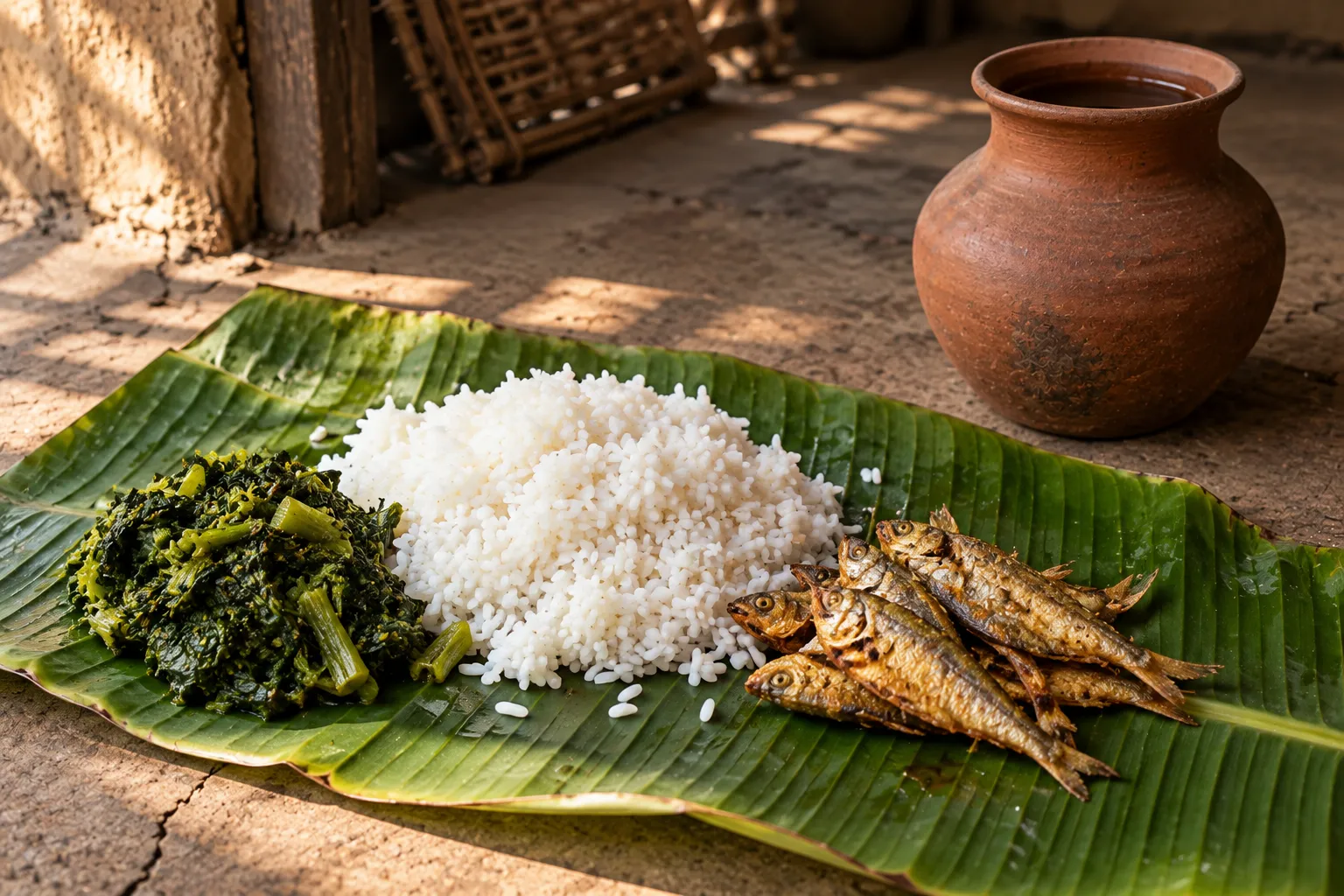
Not like a museum version of today’s table—and not like an alien cuisine either. It likely tasted of boiled rice and many dals, of river fish when the catch allowed, of mustard or sesame fat, of palm jaggery when sweetness was wanted, and of spices drawn from a pan-Indian world whose local Bengal inventory we can only partly prove. It did not taste of chilli heat, tomato sourness, potato body, panch phoron as we know it, or sandesh after the meal.
Return to that mental experiment. Clear the modern markers, and an older architecture remains: rice, pulse, fish, oil. Rebuild them, and you are watching invention as much as inheritance. The grain–fish–oil–pulse base is remarkably old; the flavour and sweet culture that now advertise Bengal to the world are comparatively young. Asking what Bengali food tasted like a thousand years ago is less nostalgia than a quiet return to the plate: how much of “taste” is inheritance—and how much is invention layered carefully, deliciously, and recently on what was already there.