
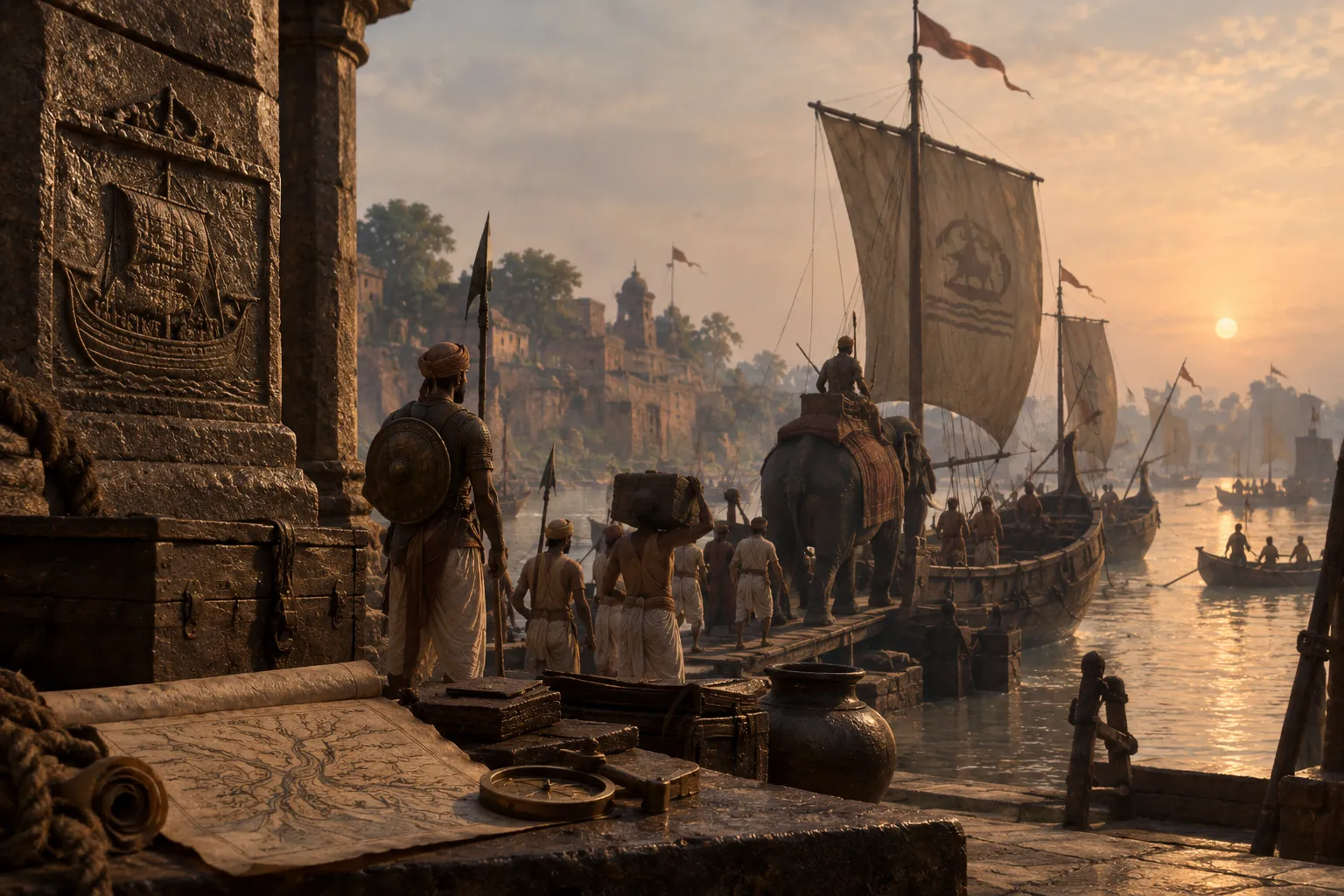
Bengal’s Navy Was Not Just a Navy
In Bengal, water was never simply the space between two pieces of land. Rivers carried armies, connected settlements and opened routes towards the sea. For rulers trying to hold together a kingdom shaped by the Ganges and its many channels, command of the waterways could be a matter of political survival.
That is why Bengal’s naval history deserves attention. Greek accounts of the Gangaridai describe a formidable power in the lower Ganges region, whose military reputation helped deter Alexander’s eastward advance. Centuries later, under the Palas and Senas, inscriptions and administrative terminology offer glimpses of naval forces and officials associated with vessels, ports and river crossings. The surviving evidence does not tell us the size of Bengal’s fleets or allow us to measure their strength against every contemporary navy. It does show, however, that military power in Bengal was closely bound to the ability to operate on water.
But a fleet’s significance is not measured only by the battles it fought. In a river-shaped kingdom, boats and the people who managed them could also help move soldiers and supplies, connect ports with inland centres, and make travel across waterways possible. To understand Bengal’s navy, we need to look beyond the moment of combat and ask what else it made possible.
A fleet needed more than fighters
The research identifies several Sanskrit titles associated with naval and riverine responsibilities. Among them are Nau-Vyapṛtaka, Pattanadhyakṣa, Nau-Karmika, Karnadhara and Tarika. Their precise duties and relationships cannot all be reconstructed with equal confidence, and they should not be mistaken for a fully documented modern naval hierarchy. Yet the terms offer a useful starting point: maritime activity involved administration, ports, navigation and crossings—not only combat.
A Karnadhara, for example, is associated with steering or piloting a vessel. The Pattanadhyakṣa is linked with port administration, while Tarika appears in the research as a river-crossing official connected with movement across waterways. These roles point towards a practical truth about Bengal: a fleet could only operate if someone knew how to guide its boats, organize its points of departure and get people safely from one bank to another.
The surviving terminology does not tell us how every office worked on an ordinary day. But it does make the administrative side of river travel visible.
The crossing was part of the campaign
For an army in Bengal, a river was never just a line on a map. It could separate a force from its supplies, delay its movement or determine where it could advance. Moving troops across a major channel required boats, crews, coordination and knowledge of the water.
The research associates Tarika with this work of river crossing and logistics. It also describes river vessels suited to different carrying needs: smaller craft for movement through inland waters and larger boats for heavier loads, including supplies. Such classifications come from the Yukti Kalpataru, a Sanskrit treatise attributed to King Bhoja. The text is not a Bengal-specific naval manual, so its categories should be treated as evidence for a wider shipbuilding tradition that may help illuminate Bengal—not as a direct inventory of every Pala vessel.
Still, the connection is worth noticing. Military mobility in a riverine landscape depended not only on the army’s strength, but on the capacity to transport it.
Ports connected the river to the wider world
A port was more than a place where a ship stopped. It was a point where journeys, goods and people met—and where administrative attention could matter. The title Pattanadhyakṣa, associated in the research with ports and commercial harbours, hints at this dimension of maritime life.
Bengal’s river networks connected inland settlements with coastal routes, while its rulers also participated in religious and diplomatic relationships extending across the Bay of Bengal. The Nalanda Copper Plate, for instance, records a request from Balaputradeva of the Śailendra world and a land grant by Pala emperor Devapala for a monastery at Nalanda. That inscription does not prove that the Pala navy controlled the sea routes, but it does document a relationship between rulers whose worlds were separated by the Bay.
The fleet’s wider setting, then, included more than the battlefield. Rivers and ports formed part of the connective tissue between political centres, religious institutions and maritime journeys.
What the evidence lets us see
It would be too neat to turn these scattered titles into a complete organizational chart or to claim that every function operated everywhere in the same way. The sources do not preserve that level of detail. They do, however, make it difficult to imagine Bengal’s naval activity as a force concerned exclusively with fighting.
A river fleet needed navigators and administrators as well as combatants. It depended on ports, boats and the movement of people and supplies. In Bengal, where waterways shaped both travel and political reach, those tasks were not separate from power. They were among the ways power became usable.
The striking point is not that Bengal’s navy performed every conceivable maritime role. It is that the evidence lets us glimpse a fleet embedded in the everyday work of governing a river-shaped kingdom. The navy was not only what happened when war reached the water; it was also part of how the kingdom moved through it.