
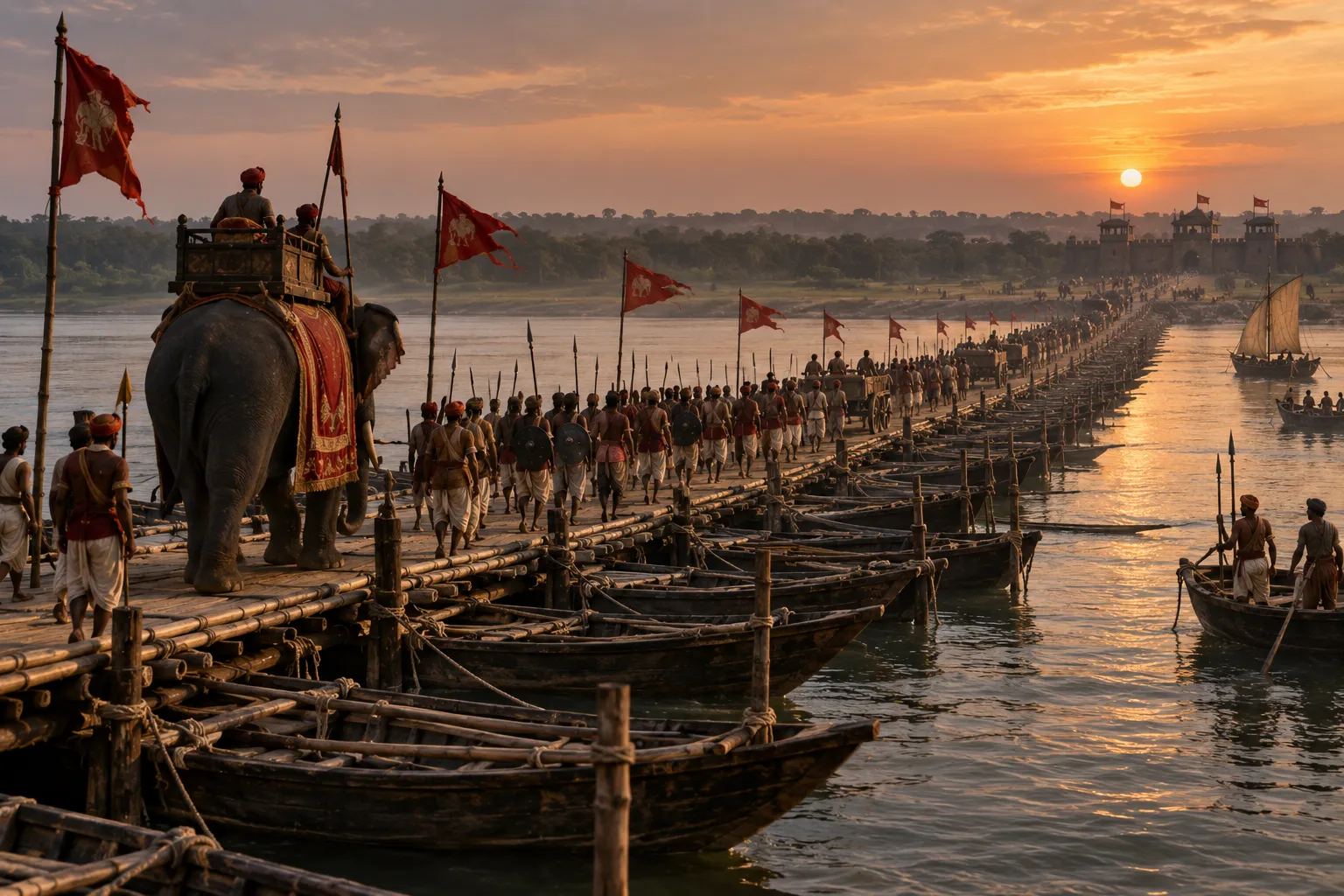
The Bridge Made of Boats
A river can protect a kingdom. It can also bring an army to a halt.
For a military force moving through Bengal, crossing a major river was not a minor inconvenience. The waterway might be wide, the current difficult, and the opposite bank held by an enemy. A force could possess elephants, infantry and supplies, yet remain stranded on the wrong side of the water.
One answer preserved in the research on Bengal’s military traditions is the Nau-Setu—literally, a bridge made of boats.
The idea is simple to imagine: instead of building a permanent bridge across a river, connect floating vessels to create a temporary crossing. But in a landscape threaded with waterways, such a structure raises a larger question: how could boats become part of an army’s infrastructure?
When the river became a military obstacle
Bengal’s rivers were more than routes for trade and travel. They shaped the movement of armies, the reach of political authority and the possibilities of warfare.
A force advancing through the delta could not simply march across every waterway. It needed boats to move people and supplies, and it needed a way to coordinate those movements with troops on land. Crossing a river under hostile conditions was especially demanding: the army had to reach the opposite bank in sufficient numbers, maintain its supplies and avoid leaving its forces divided.
A bridge of boats offered a possible solution to that problem.
Rather than relying on a fixed structure, military engineers could use vessels already suited to the water. Connected together, they could form a temporary passage across a river, allowing people and equipment to move between banks.
The concept joined two kinds of mobility—movement on water and movement across it.
What was a Nau-Setu?
The term Nau-Setu combines nau, meaning boat or vessel, with setu, a bridge or crossing. The research dossier describes it as a floating bridge used in amphibious military operations and associates the concept with Sanskrit military literature.
Its proposed functions went beyond getting soldiers from one bank to another. A boat bridge could help maintain the movement of supplies, support an advancing force and potentially serve as a platform during military operations near a river crossing.
But the surviving details are sparse. The research does not provide a complete engineering plan, a confirmed count of vessels, or a securely documented account of a particular Bengal campaign in which a Nau-Setu was assembled exactly as reconstructed.
That distinction matters. The military concept is described; the precise form of its use in Bengal remains less certain.
How might the crossing have worked?
Imagine an army approaching a broad river.
Boats would first have to be brought together at a suitable crossing point. If arranged and secured side by side, they could provide a floating support for a passage across the water. Some form of decking or other surface might then allow people to cross more easily, although the available research does not establish a standard construction method for Bengal’s Nau-Setu.
The difficult work would not end once the bridge was assembled. The structure had to remain usable while people moved across it, and the boats had to withstand current, shifting water levels and the weight placed upon them.
This is where the idea becomes more than a clever arrangement of vessels. It implies coordination: boats, crews, soldiers and supplies had to work together within a limited window of time.
A temporary bridge could only be useful if the army could organise the crossing around it.
More than a passage for soldiers
The research associates the Nau-Setu with several military functions: river crossing, supply movement and support for amphibious operations. It also proposes that connected boats could provide a platform from which soldiers operated near enemy positions.
These uses should not be treated as equally well documented. The dossier offers a broad reconstruction of what such a bridge could do, but it does not establish that every proposed function was routinely performed by Bengal’s armies.
Even the more basic role—moving a force across a river—has wider implications. An army that could organise a temporary crossing would have more options than one dependent entirely on existing bridges, ferries or favourable river conditions.
The bridge would not make the river disappear. It would make the river crossable on the army’s terms, at least when circumstances allowed.
The engineering hidden inside the idea
A bridge made of boats sounds improvised, but a functioning crossing would demand careful organisation.
The vessels would need to be positioned and held together. The crossing point would have to suit the river’s conditions. People and loads would need to move in a controlled way, and the structure would have to remain stable enough for the intended use.
The research’s description of the Nau-Setu points towards military logistics as an essential part of river warfare. Yet it leaves many practical questions unanswered: how the boats were secured, how the passage was surfaced, how it was protected, and how long a crossing could remain operational.
Those gaps are not invitations to invent a detailed blueprint. They are reminders that the surviving description preserves the idea more clearly than its exact execution.
A bridge that moved with the army
The significance of the Nau-Setu lies in the way it connects Bengal’s waterways with the organisation of military power.
A permanent bridge belongs to a place. A boat bridge, in principle, could be assembled where a crossing was needed and dismantled when the army moved on. That flexibility would have been valuable in a region where rivers shaped routes and where military movement depended on access to boats and experienced crews.
The available evidence does not let us reconstruct every crossing or measure how frequently this method was used. It does, however, preserve a military idea that fits the larger amphibious setting described in the research: boats were not merely transport. They could become temporary infrastructure.
In Bengal, the river was not only something an army had to cross. It was something the army could learn to build across.