
From Ganapati to Ganesha: How Did the God We Know Take Shape?
There is something curious about Ganesha. He seems to have been part of Indian religious life forever: the elephant head, the little mouse, the broken tusk, the sweet modak, and the familiar belief that no auspicious undertaking should begin without invoking him.
But the historical story is more complicated—and more interesting.
The word gaṇapati is already present in the Rigveda. In one famous hymn, the poet calls upon the gaṇapati, “lord of the hosts”. Yet the hymn, Rigveda 2.23, is addressed to Brahmaṇaspati, not to the elephant-headed deity we know today. The ancient word is real; the later identification is the historical question.
So how did Gaṇapati become Ganesha?
A very old name, but a changing identity
The Sanskrit gaṇa can refer to a group, company or assembly, while pati means lord or master. Gaṇapati, therefore, could function as a title: the lord or leader of a group.
In the Rigveda, that title belongs within the religious vocabulary surrounding Brahmaṇaspati. The same Vedic tradition gives us a world of gods whose identities and attributes were not yet arranged in the familiar form of later Hinduism.
That distinction is important because it prevents an easy mistake. The presence of the word gaṇapati in the Vedas proves the antiquity of the word and its divine usage; it does not, by itself, prove that the Vedic gaṇapati was already the elephant-headed Ganesha.
The Ganesha of later Hindu tradition emerged through a much longer process.
When the elephant-headed god comes into view
The familiar visual form of Ganesha becomes much easier to recognise in the historical record during the early centuries of the Common Era, particularly in the Gupta and post-Gupta periods.
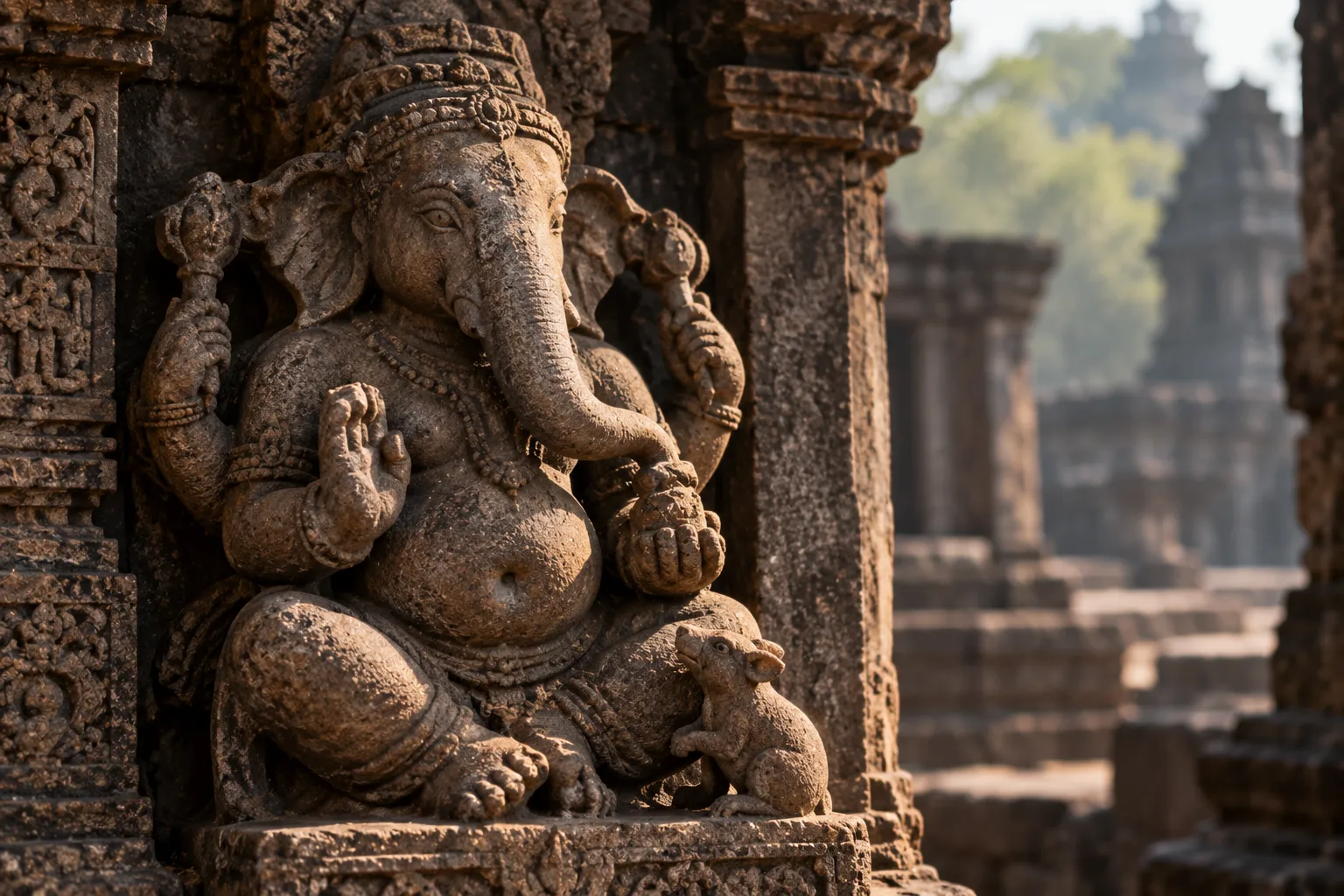
This is when representations of an elephant-headed, human-bodied deity become increasingly visible in sculpture and religious art. Over time, Ganesha acquires the attributes that now seem inseparable from him: multiple arms, weapons and ritual objects, the broken tusk, the distinctive belly, and eventually the small animal beneath him.
The transformation was not simply artistic.
A deity’s image carries a theology with it.
The elephant head could evoke strength, intelligence and authority. The deity’s association with beginnings and obstacles became increasingly important. Different regional traditions contributed stories and symbols until the figure became recognisable across much of the subcontinent.
We should therefore be careful about looking for one moment when “Ganesha was invented”. Religious identities rarely work that way.
The stories came later—or at least, some of them did
Many of the stories that now seem fundamental to Ganesha belong to the later mythological tradition.
The story of Parvati creating a child to guard her doorway, Shiva cutting off the child’s head and then restoring him with an elephant’s head explains the form in a memorable way. Another famous story explains why Ganesha is worshipped before other gods: when the gods are challenged to circle the universe, Ganesha simply circles his parents, Shiva and Parvati, declaring that they represent the universe itself.
These stories are powerful precisely because they turn an unusual image into a meaningful one.
The same is true of the famous story that Ganesha wrote down the Mahabharata as Vyasa dictated it. It is deeply embedded in later tradition, but it should not be projected backwards into the earliest recoverable form of the epic as though the story had always been there.
Mythology gave the increasingly familiar Ganesha a biography.
Why an elephant—and why a mouse?
Here the history becomes especially intriguing.
One interpretation sees Ganesha’s elephant imagery in relation to older traditions in which elephants carried associations of strength, fertility, rain, forests and agricultural life. Similar symbolic associations surrounding elephants occur across South Asian religious cultures, including Buddhist and Jain traditions.
Some scholars have also explored the possibility that elements of Ganesha’s cult absorbed or transformed older local and non-Brahmanical traditions. The idea that Ganesha simply began as a single “tribal elephant god” and was later adopted wholesale by Brahmanical Hinduism, however, is much harder to establish as historical fact.
The evidence points towards layering rather than a single origin story.
Even the mouse beneath Ganesha may belong to this process. The animal has been interpreted in relation to fertility, abundance and the agricultural world, while its eventual role as Ganesha’s vāhana, or vehicle, creates one of the most memorable contrasts in Indian religious art: an enormous elephant-headed god riding a tiny creature.
The symbolism almost invites interpretation.
Power does not always travel on something powerful.
And then Ganesha entered Bengal
By the medieval period, Ganesha was no longer an unfamiliar or marginal figure in the religious culture of eastern India. His presence appears in the broader artistic and literary world of Bengal, and invocations to him became part of the auspicious opening traditions of Bengali literature, including the mangalkavya tradition.
That development matters because the Ganesha of Bengal was not simply a sculpture imported from somewhere else.
He became part of the cultural grammar of beginning.
A poem could begin with his invocation. A household ritual could invoke him before another deity. A new undertaking could begin with his name. The god whose mythology centred increasingly on removing obstacles became, almost naturally, the god one remembered before starting something.
His position in Bengali culture therefore tells us something about cultural assimilation. A deity does not become familiar merely because people know his mythology. He becomes familiar when his presence begins to feel necessary.
From household god to public festival
The Ganesha Chaturthi celebrated today has another, much more recent chapter.
Ganesha worship has deep regional histories, particularly in western India, but the transformation of Ganesh Chaturthi into a large public festival is closely associated with the late nineteenth century. Bal Gangadhar Tilak helped turn the festival into a public cultural and political gathering in Maharashtra from the 1890s, giving it a new collective significance under colonial rule.
This modern public festival should not be confused with the much older history of Ganesha worship.
They are different layers of the same story.
The god is ancient in ways that cannot be reduced to the modern festival; the particular form of mass public celebration is comparatively recent.
The god who kept changing
Perhaps that is the most revealing thing about Ganesha.
There is no need to choose between calling him “ancient” and calling his familiar form “later”. Both observations can be true.
The word gaṇapati belongs to the Vedic world. The elephant-headed Ganesha belongs to a later stage of South Asian religious history. His mythology continued to expand, his iconography accumulated new attributes, regional cultures gave him new meanings, and Bengali society eventually made him part of its own literary and ritual landscape.
Ganesha was not created once. He was assembled across centuries.
That may explain why he feels so completely at home in so many different settings. He can be a deity of wisdom, an auspicious guardian, a remover of obstacles, a character in a Puranic story, a figure at the beginning of a Bengali poem, or the centre of a modern public festival.
His elephant head is immediately recognisable.
His history is anything but simple.