
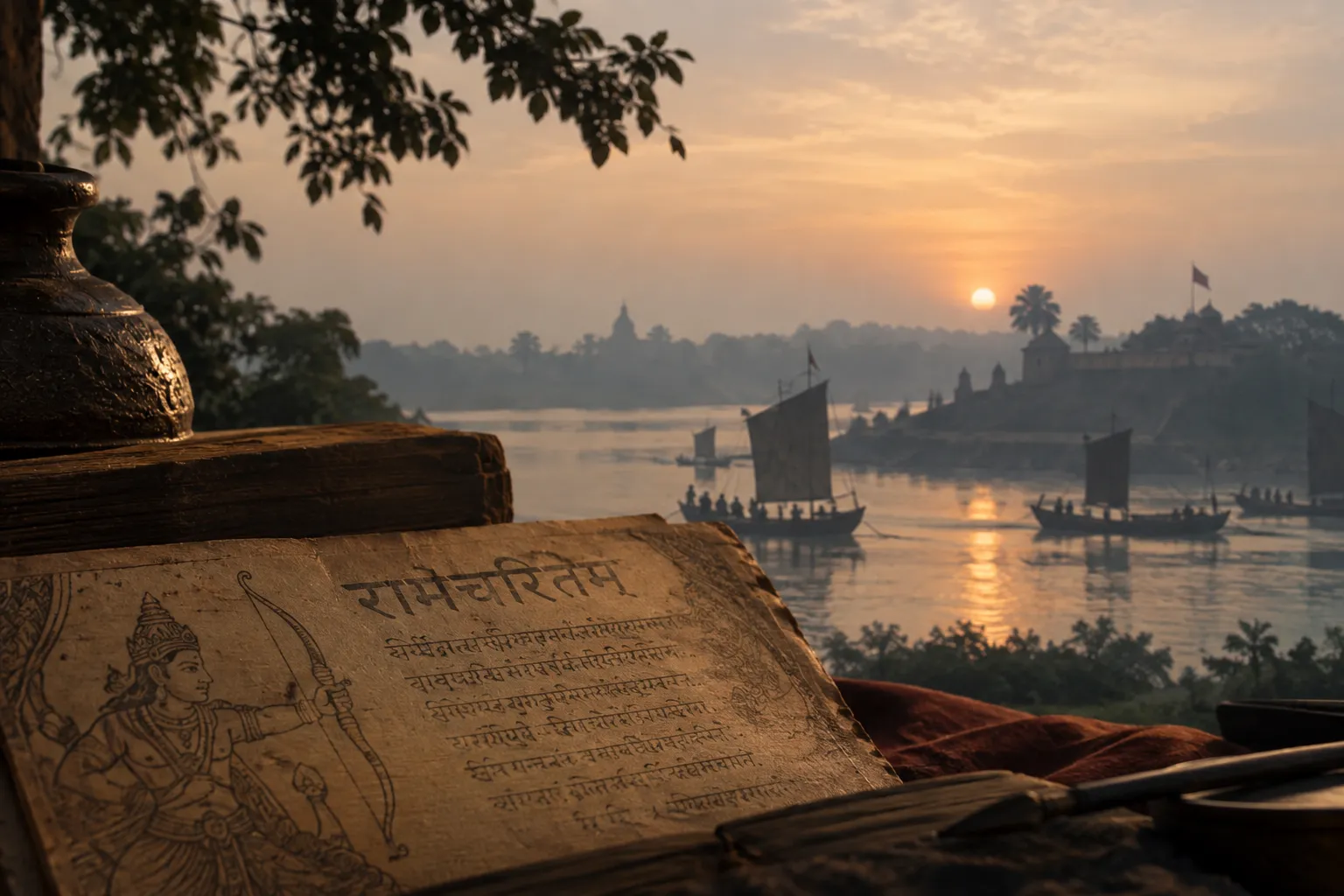
The River Battles of the Ramacharitam
A king can lose a kingdom without losing his title. In the eleventh century, the Pala ruler Mahipala II lost control of Varendra, a region in northern Bengal, after a revolt led by a man named Divya. The Pala dynasty survived, but its authority over this important territory had been broken. Recovering it would become the task of Mahipala’s successor, Ramapala.
The struggle is remembered in the Ramacharitam, a Sanskrit poem by Sandhyakar Nandi. It tells of a political conflict in Bengal, but it does so through a literary work shaped by royal praise—and, unusually, through a poem whose story is intertwined with the tale of Rama.
That makes the Ramacharitam more than a record of a lost province and a recovered kingdom. It is also a glimpse of how a medieval court wanted power, defeat and restoration to be remembered.
A revolt that changed the balance of power
The Kaivarta leader Divya rose against Mahipala II and established control over Varendra. After Divya, the region was ruled by Rudoka and then Bhima. By the time Ramapala moved to recover it, the challenge was not simply to suppress a brief disturbance. Pala authority had to be re-established in a territory held by successive rulers.
The Kaivartas are often associated with fishing and river-dependent livelihoods, but the revolt should not be reduced to a story of fishermen taking up arms. The surviving evidence does not tell us that every Kaivarta was a professional sailor or warrior. What it does show is that a regional power could challenge the ruling dynasty and hold territory against it.
That is the political significance of the episode. Varendra was not merely a place Ramapala had to reconquer; its loss exposed the limits of Pala authority.
Why the river matters
Varendra belonged to a landscape shaped by rivers. Waterways connected settlements and supported movement, but they could also complicate a ruler’s ability to project power. A campaign in this region necessarily unfolded within a world where the landscape influenced communication, travel and military movement.
The Ramacharitam is an important source for the conflict, but it does not provide the kind of operational record that would allow us to reconstruct every crossing, vessel or battlefield manoeuvre. We should not turn its literary descriptions into a detailed naval account without specific evidence.
The river setting matters in a more fundamental way. The contest was over control of a region whose geography shaped how people lived and moved. The power of a local force and the challenge of restoring royal authority cannot be separated entirely from that landscape.
A history told through the story of Rama
Sandhyakar Nandi’s poem has a distinctive literary design: it brings together the story of Ramapala and the story of Rama. This double narrative gives the work a significance beyond the events it recounts. The king’s recovery of Varendra is presented within a literary world already rich with associations of rightful rule, conflict and restoration.
That does not mean the poem is simply a disguised retelling of the Ramayana, nor that every detail of the historical campaign corresponds to an episode in Rama’s story. Its literary structure is part of how the author shapes the account, and it reminds us that the poem was composed for an audience familiar with the cultural authority of epic narrative.
For historians, this is both an opportunity and a caution. The poem preserves political names and the memory of a major struggle, but its language and emphases are also shaped by the courtly setting in which it was written.
The king who returned—and the voice that remembers him
Ramapala eventually recovered Varendra from Bhima. In the Ramacharitam, that recovery becomes the centre of a story about the restoration of Pala power. The poem gives us a view of the conflict from the side that prevailed, and its account should be read with that perspective in mind.
Yet the courtly character of the source does not erase the historical importance of the revolt. The sequence of rulers in Varendra, the loss of Pala control and Ramapala’s campaign point to a real political rupture. The poem’s praise of the victor coexists with evidence that the dynasty had faced a challenge serious enough to shape its history.
This is where the Ramacharitam becomes especially valuable. It lets us study not only a struggle for territory, but also the language through which a ruling court made sense of defeat and recovery.
Reading the river battles carefully
The title “river battles” can conjure images of fleets, manoeuvres and dramatic encounters on the water. The evidence calls for a more measured approach. We know that the conflict unfolded in river-shaped Varendra, and the Ramacharitam preserves its memory. We do not have enough detail to reconstruct every naval action or claim that a particular tactic decided the outcome.
What survives is still revealing: a regional revolt that displaced Pala authority, a campaign that restored it, and a poem that turned that recovery into a royal narrative.
The Ramacharitam asks us to read two things at once—the history of a contested kingdom and the literary imagination of the court that regained it. Its rivers belong to the landscape of the conflict; its poetry shows how the victors wanted that conflict to endure in memory.