
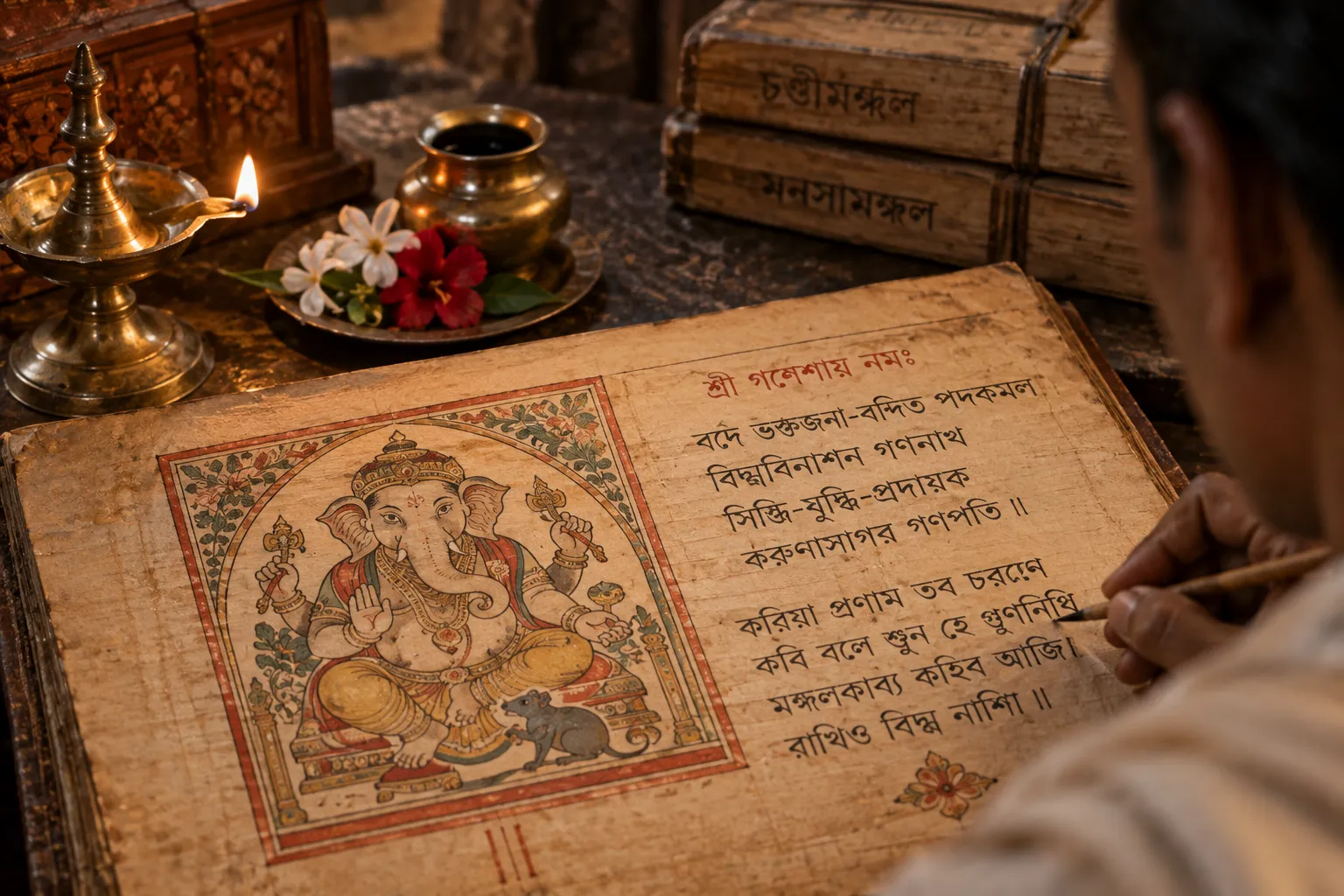
Why Did Ganesha Become the First Voice of the Bengali Maṅgal-kāvya?
Before a story about a goddess could begin, a Bengali poet often had something else to do first.
He had to ask for permission.
The opening of a Maṅgal-kāvya was traditionally a vandana—an invocation in which the poet praised deities, teachers and other figures before entering the main narrative. This was not decorative preliminaries. It established auspiciousness and prepared the literary world in which the story would unfold.
And in many of the surviving Bengali Maṅgal-kāvyas, one figure appears remarkably early in that ritual-literary sequence:
Ganesha.
Why him?
The god before the story
The Maṅgal-kāvya tradition developed around narratives celebrating particular deities, many of whom belonged deeply to Bengal’s regional religious culture. Manasā-maṅgal, Caṇḍī-maṅgal and Dharma-maṅgal, for example, centred on different divine figures and their establishment or expansion of worship. The poems were not simply religious stories; they were also vast portraits of medieval Bengali society, landscape, occupations and social relationships.
Yet the deity whose story was about to be told was not necessarily the first deity the poet addressed.
That is where Ganesha becomes interesting.
The opening vandana could invoke several gods before the narrative proper began, and Ganesha frequently occupied a privileged position within this sequence. In Caṇḍī-maṅgal, for instance, Mukundaram Chakrabarti’s poem begins its devotional section with Ganesha before moving through other divine figures. Later Bengali Maṅgal-kāvyas continued the convention.
The literary convention mirrors Ganesha’s wider religious identity.
He was the god one remembered before beginning.
Why Ganesha suited a Bengali poem
Ganesha’s association with auspicious beginnings made him particularly well suited to the opening of a long narrative poem.
A poet was not simply starting a story. He was beginning an act of composition, performance and religious communication. The invocation asked for the removal of obstacles and for the work to reach its proper completion.
That makes the opening of a Maṅgal-kāvya more than a literary convention.
It is a small ritual.
The poet establishes a relationship with the divine before asking the audience to enter the story.
And Ganesha’s presence makes perfect sense within that logic.
The interesting part: Ganesha was not the main character
There is a subtle irony here.
The Maṅgal-kāvya was usually written to establish the greatness of a particular deity. In Manasā-maṅgal, the central religious purpose concerns Manasā. In Caṇḍī-maṅgal, it is Caṇḍī. In Dharma-maṅgal, Dharma Ṭhākur takes the central position.
Ganesha does not need to dominate their stories.
He simply needs to come first.
That distinction tells us something about his position in Bengali religious culture. By the time these literary traditions were flourishing, Ganesha did not need his own narrative to justify his presence. His role as an auspicious opener had become sufficiently familiar for poets to invoke him before turning to another deity.
He was becoming part of the grammar of beginning itself.
Sanskrit tradition, Bengali poetry
This does not mean that Bengali poets invented the practice independently.
Scholars of eastern Indian religious literature have noted that the vandana at the beginning of Maṅgal-kāvya drew heavily upon the wider Sanskritic and Puranic tradition. The Bengali poet was therefore working within a much larger religious vocabulary while adapting it to a regional literary form.
This is one of the most revealing features of the Maṅgal-kāvya tradition.
It did not simply replace Sanskrit religion with Bengali folk religion, nor did it merely copy Sanskrit models.
It combined them.
Regional gods, local landscapes, village society and Bengali narrative forms could exist alongside figures from the wider Hindu pantheon. Ganesha’s place in the opening invocation is a particularly clear example of this cultural meeting.
A god who crossed the threshold
Look at what happens when the poem begins.
First comes the invocation. Then comes the poet. Then comes the story.
Ganesha stands at that threshold.
He belongs to the larger religious world of India, but he has become completely at home inside a Bengali literary form. He can be invoked before the story of a snake goddess, a powerful regional goddess or a Bengali deity without disturbing the identity of the poem.
In fact, his presence helps establish the poem’s legitimacy.
The message is subtle: this new Bengali story belongs within a much older sacred universe.
That may be one reason the convention lasted.
From manuscript page to Bengali culture
The importance of Ganesha in the Maṅgal-kāvya tradition therefore goes beyond the question of whether medieval Bengalis worshipped him.
Of course they did.
The more interesting question is what kind of place he occupied in their cultural imagination.
A deity can be important because people build temples to him. Another can become important because people tell stories about him. Ganesha acquired another kind of importance as well: he became the figure who could stand at the beginning of an act of creation.
A poet could invoke him before writing about another god.
A performer could invoke him before beginning the tale.
An audience could recognise the gesture immediately.
The elephant-headed god had become part of the machinery of the story itself.
The first line mattered
This is why the opening of a Maṅgal-kāvya deserves more attention than it usually receives.
Before Bengal’s medieval poets took us into forests, merchant voyages, divine quarrels, village settlements and miraculous encounters, they paused to create auspiciousness.
And very often, Ganesha was there.
Not as the hero.
Not as the deity whose greatness the entire poem had been commissioned to establish.
But as the god who stood quietly at the doorway.
Before the story could begin, Bengal’s poet first made sure the beginning itself was blessed.